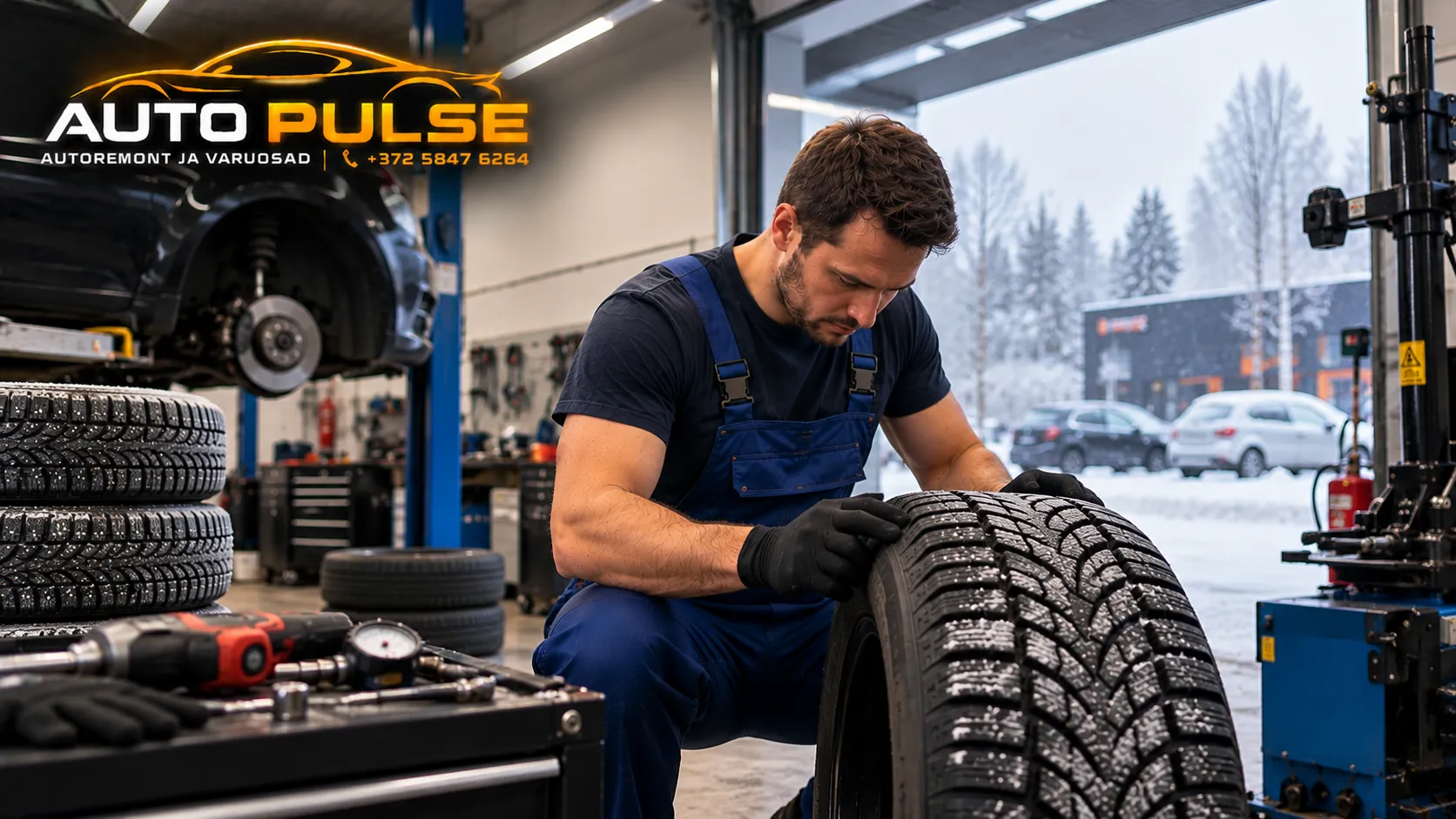
The weather in Estonia can be unpredictable. Yesterday, the roads in Tallinn were dry, but this morning, cars are covered in snow, temperatures have dropped below zero, and ice has formed on the asphalt.
In such situations, many car owners ask: what should you do if early snow falls while your car is still on summer tires?
The most important thing is not to rush out. The first snowfall requires a careful assessment of road conditions, tire status, and the vehicle’s readiness for winter use.
If there is snow or black ice on the road, using summer tires can be dangerous even at low speeds.
Experts at AutoPulse have prepared a practical checklist for drivers in Tallinn and across Estonia. We will discuss when it is best to cancel a trip, what to check before setting off, how to drive safely during snowfall, and what requirements for winter tires apply in 2026.
Evaluating the situation: Can you drive on summer tires?
The first thing you need to do after an unexpected snowfall is assess the road conditions.
Summer tires are primarily designed for use in warm weather. Their rubber compound and tread pattern differ from those of winter models.
On snow and ice, summer tires usually provide significantly less grip than appropriate winter tires.
This affects:
- The braking distance of the vehicle.
- Stability in corners.
- The ability to accelerate safely.
- The effectiveness of emergency braking.
- Handling when avoiding obstacles.
Why does +7 °C matter?
A temperature around +7 °C is often used as a practical guideline for seasonal tire changes.
However, this does not mean that summer tires become instantly unsuitable once this threshold is reached.
Tire performance depends on the specific model, rubber compound, road surface temperature, and weather conditions.
The main danger arises when snow, ice, and frozen moisture appear.
If your vehicle is equipped with summer tires and the road is covered in snow or ice, it is safer to cancel the trip until an appropriate winter set is installed.
Do not assume that a short distance to a tire service makes such a trip safe.
If necessary, arrange for the vehicle to be transported to the service center instead of driving it yourself on slippery roads.
When is it especially dangerous to set off?
It is recommended to postpone your trip if:
- Black ice has formed on the road.
- Snow has not been cleared from the roadway.
- Temperatures are near zero and continuing to drop.
- You will be driving on bridges, overpasses, or steep inclines.
- Visibility is severely limited by snowfall.
- The vehicle is not prepared for winter conditions.
If you discover that your winter tires need replacement, check the cost of tire services in Tallinn in advance.
Emergency checklist: 5 steps before setting off
If the first snow falls, take a few minutes to inspect your vehicle.
Even with high-quality winter tires, faulty wipers, insufficient tire pressure, or poor visibility can create a hazardous situation.
1. Visibility: Wipers and antifreeze washer fluid
First, check the condition of the windshield and the operation of the wipers.
Summer washer fluid may freeze at negative temperatures.
This is particularly dangerous while driving, when snow, dirt, and road chemicals get onto the glass.
Before setting off, it is recommended to:
- Check the freezing point of the washer fluid.
- Replace it with a winter-grade fluid if necessary.
- Ensure that the washer nozzles are working.
- Check the condition of the wiper blades.
- Clear ice and snow from the glass.
For winter use, fluids with a freezing point of −20 °C or lower are often chosen, depending on expected weather conditions.
Do not turn on the wipers if the blades are frozen to the glass. This can damage the rubber elements or the drive mechanism.
2. Checking tire pressure and tread condition
As temperatures drop, air pressure in tires usually decreases.
Therefore, after a sudden cold snap, it is recommended to check pressure with a gauge.
Use the values recommended by the vehicle manufacturer.
These are typically listed on the information sticker in the door jamb, on the fuel filler cap, or in the owner’s manual.
Also check the condition of your winter tires.
Pay attention to:
- Remaining tread depth.
- Cracks and cuts.
- Sidewall bulges.
- Uneven wear.
- Foreign objects in the tread.
During the mandatory winter period in Estonia, the minimum allowable tread depth for winter tires is 3 mm.
However, for confident driving on snow and slush, it is recommended to consider replacement when the remaining tread depth reaches approximately 4–5 mm.
3. Battery and lighting
At low temperatures, the battery has more difficulty providing the necessary starting current.
If the battery is already worn, the first frosts can lead to engine start-up problems.
Before the winter season, it is recommended to check:
- The condition of the battery.
- The reliability of terminal connections.
- The absence of severe contact oxidation.
- Generator operation if signs of malfunction are present.
- The functionality of external lighting.
Pay special attention to low beams, turn signals, brake lights, and rear lights.
In snowfall, the vehicle must be clearly visible to other road users.
4. Completely clearing the vehicle of snow and ice
Before setting off, you must clear the vehicle of snow and ice.
It is not enough to remove snow only from the windshield.
While braking, snow from the roof can slide onto the windshield and block your view.
Additionally, chunks of snow can fly off the vehicle while driving, creating a hazard for other road users.
Clear:
- Front and rear windshields.
- Side windows.
- External mirrors.
- The vehicle roof.
- Hood and trunk.
- Headlights and taillights.
- License plates.
Do not start moving until visibility is fully restored.
5. Planning your route and allowing extra time
During the first snowfall, a usual trip through Tallinn may take significantly longer.
Traffic slows down, congestion occurs at intersections, and certain road sections become slippery.
If possible, choose routes without steep climbs and descents.
Be especially cautious on bridges and overpasses, where the road surface cools faster.
Before your trip:
- Check the weather forecast.
- Verify traffic conditions.
- Allow additional time.
- Avoid unnecessary trips.
- Ensure the vehicle is technically sound.
If weather conditions are too severe, it is wiser to postpone your trip.
How to drive during the first snowfall
If your vehicle is equipped with suitable winter tires and the trip is truly necessary, it is important to adjust your usual driving style.
The main rule for driving on slippery roads is smoothness and increased safety margins.
Increase following distance
On snow and ice, braking distance can increase significantly.
Therefore, you need to leave more space between your vehicle and the one ahead.
The specific safe distance depends on speed, road surface condition, tires, and visibility.
The normal distance sufficient for summer driving on dry asphalt may be inadequate in winter.
Avoid abrupt maneuvers
Sudden acceleration, braking, or steering can lead to loss of traction.
Try to:
- Accelerate smoothly.
- Reduce speed in advance.
- Avoid abrupt lane changes.
- Refrain from unnecessary overtaking.
- Navigate turns at a safe speed.
Pay particular attention to vehicle behavior on sections with uneven road surfaces.
Use brakes correctly
In modern vehicles with a functioning ABS system, during emergency braking, firmly press the brake pedal and maintain the required force, allowing the system to prevent wheel lockup.
There is no need to perform intermittent braking instead of relying on ABS.
For normal deceleration, brake smoothly and in advance.
Be cautious with cruise control
On slippery roads, it is recommended to avoid using cruise control unless the vehicle manufacturer provides a safe mode for these conditions.
The driver should manually control speed and react promptly to changes in traction.
Beware of “black ice”
Black ice is a thin, transparent layer of ice on the road surface that can be nearly invisible.
Dangerous spots are frequently found:
- On bridges.
- On overpasses.
- In shaded areas.
- On roads near water bodies.
- In areas with high humidity.
If you suspect black ice, reduce speed gradually and avoid abrupt actions.
Legal aspects: Tire usage rules in Estonia
In Estonia, the mandatory period for using winter tires on passenger cars subject to this requirement runs from December 1 to March 1.
However, legal deadlines do not always coincide with the actual onset of winter road conditions.
Can you drive on summer tires in November?
Using summer tires in November does not, in itself, violate the mandatory seasonal requirement.
However, drivers must consider road conditions and choose a safe speed.
If there is snow or ice on the road, summer tires may not provide adequate traction.
Therefore, even before the mandatory winter period begins, it is recommended to use suitable winter tires when winter conditions arise.
When are studded tires permitted?
In Estonia, the standard permitted period for using studded tires is from October 15 to March 31.
Under winter road and weather conditions, an extended period from October 1 to April 30 is allowed.
Non-studded winter tires meeting requirements can be used year-round.
Current regulations can be verified on the official website of Transpordiamet.
What happens to insurance in case of an accident?
Using tires that do not match road conditions or technical requirements may be relevant during accident investigations.
However, insurance payouts are not automatically denied solely because the vehicle was equipped with summer tires.
Insurance consequences depend on the circumstances of the incident, the causal link between the violation and the accident, the type of insurance, and applicable legislation.
Why you shouldn’t delay tire replacement until the first snow
The first snowfall is usually accompanied by a surge in demand for tire services.
Many drivers simultaneously try to book appointments for seasonal tire changes.
As a result, convenient dates may quickly become unavailable.
Early preparation allows you to:
- Avoid seasonal rush.
- Choose a convenient visit time.
- Inspect the condition of your winter tire set.
- Purchase new tires if needed.
- Plan your budget.
- Prepare the vehicle before difficult weather conditions arrive.
It is better to change tires based on weather forecasts rather than waiting for the first snowfall.
If snow has already fallen and your car is still on summer tires, do not risk safety for the sake of an urgent trip.
Assess road conditions and arrange for a safe tire change.
You can view available services in the section “AutoPulse Tire Service”.
Frequently Asked Questions (FAQ)
Can you drive on summer tires if snow suddenly falls?
If the road is covered in snow or ice, driving on summer tires is dangerous.
It is better to cancel the trip until an appropriate winter set is installed.
Even a short trip to a tire shop does not guarantee safety.
Are you fined for summer tires during early snow in Estonia?
The mandatory period for winter tire use begins on December 1.
Therefore, having summer tires in November does not automatically result in a fine for violating seasonal requirements.
However, drivers must comply with other road safety requirements and consider actual conditions.