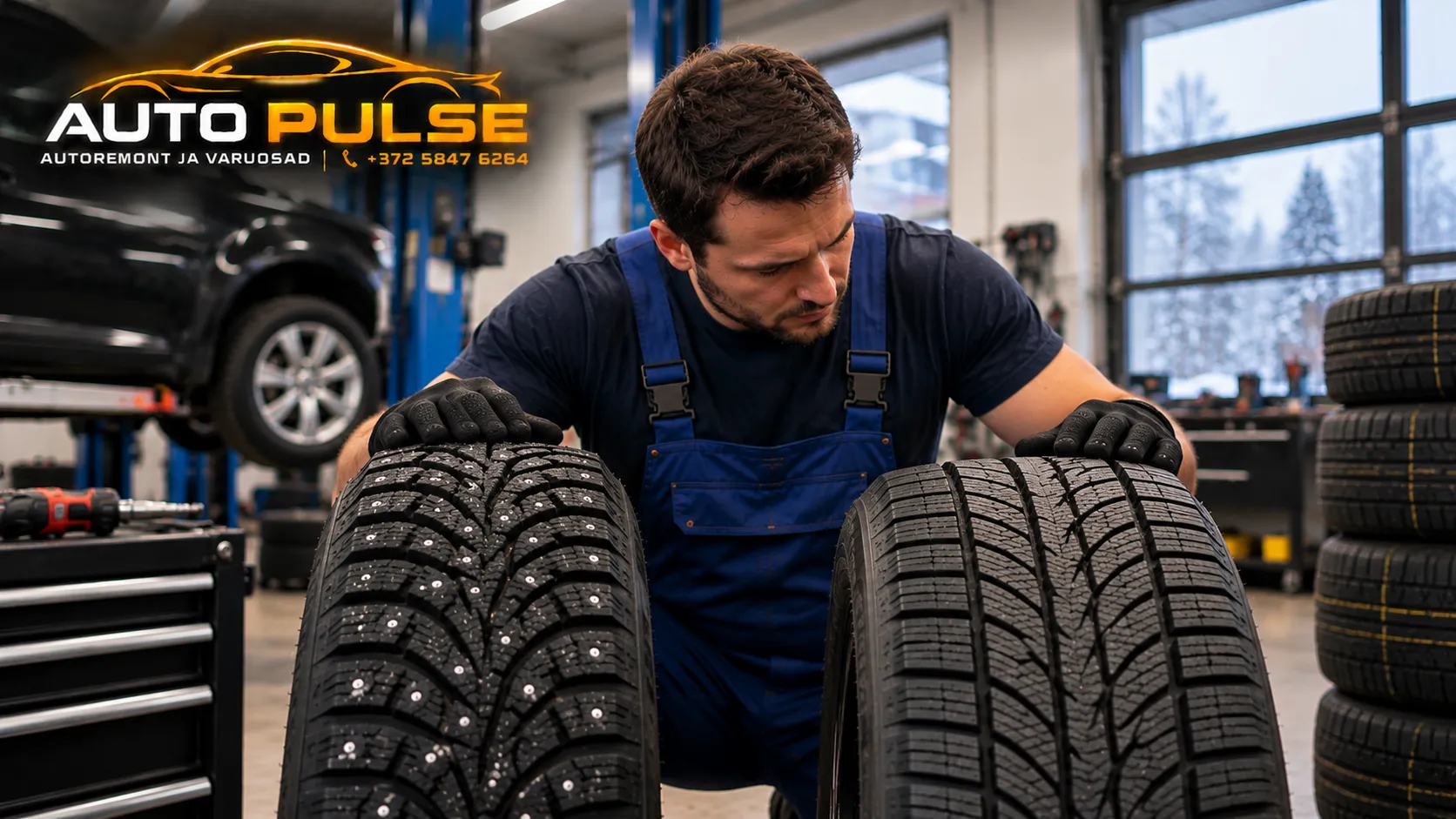
With the onset of cold weather, every car owner faces an important question: which winter tires are better to choose — friction (studless) or studded?
For drivers in Estonia, this choice is especially relevant. In winter, the weather can change several times a day: in the morning in Tallinn, there is wet asphalt and above-freezing temperatures, while in the evening on a country road, there is snow, ice, and below-freezing temperatures.
To understand the difference between friction and studded tires in Estonia, it is necessary to consider not only the cost of the set, but also the operating conditions, traction on different surfaces, noise level, and current legal requirements.
In this article, the experts at AutoPulse will compare the main characteristics of winter tires, explain the difference between Scandinavian and European friction models, and help determine which option is better suited for driving in Tallinn and on country roads.
The main principle: how studded and friction tires work
Both types of winter tires are designed for operation in cold conditions, but they provide traction with the road surface in different ways.
How studded winter tires work
Studded tires are equipped with metal studs that help create additional mechanical traction on ice.
When driving on an icy surface, the studs interact with the top layer of ice and improve the wheel’s ability to transmit braking and traction forces.
The main advantages of studded tires:
- Good traction on ice.
- Effective braking on icy sections.
- Confident starting on slippery inclines.
- Additional traction reserve on some types of packed snow.
However, studded tires also have disadvantages.
When driving on cleared asphalt, the studs create additional noise and contribute to road surface wear.
In addition, the use of studded tires in Estonia is limited to specific calendar periods.
How friction winter tires work
Friction tires, often referred to as studless tires, do not have metal studs.
Their traction is ensured by a combination of several factors:
- A special rubber compound composition.
- The tread pattern.
- A large number of sipes.
- The shape and arrangement of the tread blocks.
- The ability to evacuate water and slush.
Sipes are thin slits in the tread blocks.
They create additional gripping edges and help the tread adapt to the road surface.
Contrary to a common explanation, sipes do not work like ordinary suction cups. Their effectiveness is primarily related to the interaction of the tread edges with the surface and the specific deformation characteristics of the rubber.
High-quality friction tires are capable of providing good traction on snow and ice without the use of metal studs.
At the same time, their performance significantly depends on the specific model.
Scandinavian and European friction tires: what is the difference?
Not all studless winter tires are the same.
Typically, two main categories are distinguished: Scandinavian and European winter models.
Scandinavian type of winter tires
Scandinavian, or Nordic, friction tires are designed primarily for cold winters with frequent snowfalls and icy roads.
They are usually characterized by:
- A softer rubber compound.
- A larger number of sipes.
- A tread designed for snow and ice.
- Good traction characteristics at low temperatures.
Such tires are especially relevant for drivers who regularly encounter black ice, packed snow, and insufficiently cleared roads.
However, some Scandinavian models may be inferior to European winter tires in terms of handling precision and braking on warm, wet asphalt.
European type of winter tires
European friction tires are developed primarily for milder winters, where rain, wet asphalt, and slush are frequently encountered.
Their characteristic features include:
- A rubber compound that is stiffer compared to Nordic models.
- Pronounced water-evacuating grooves.
- Good stability on wet asphalt.
- More precise steering responses in moderately cold weather.
At the same time, on clear ice, European winter tires often fall short of Scandinavian models and high-quality studded tires.
For Estonia, it is important to choose not just any studless winter tire, but a specific model suitable for your usual driving conditions.
Comparison of characteristics: studded tires or studless?
To clearly assess the differences, let us compare the main characteristics of the three types of winter tires.
| Parameter | Studded | Scandinavian friction | European friction |
| Traction on ice | Usually very good | Good or very good | Usually weaker |
| Packed snow | Good | Good | Depends on the model |
| Wet asphalt | Depends on the model | Depends on the model | Often a strong point |
| Noise level | Usually higher | Usually lower | Usually lower |
| Road surface wear | Higher due to studs | Lower | Lower |
| City comfort | Good, but noise is possible | High | High |
| Seasonal restrictions in Estonia | Yes | No general seasonal ban | No general seasonal ban |
The table shows typical features of tire categories, not the results of comparative tests of specific models. Actual braking, traction, and stability may vary significantly.
Which tires brake better on ice?
On smooth ice, high-quality studded tires often have an advantage due to the mechanical interaction of the studs with the surface.
However, modern Scandinavian friction models can also demonstrate high performance.
Much depends on the ice temperature, its structure, and the tire design.
Which tires are better on wet asphalt?
European winter tires are often developed with a special emphasis on wet roads.
Therefore, they can provide more precise handling and good braking characteristics on cleared asphalt.
However, it cannot be stated that any European friction tire is necessarily better than any studded tire.
When choosing, it is advisable to consider the results of independent tests of specific models.
Features of the Estonian climate: which tires are really needed?
In Estonia, weather conditions can vary significantly depending on the region, time of day, and route.
Therefore, there is no universal solution for all drivers.
Tallinn: frequent thaws and wet asphalt
If the car is mostly used on the main city roads of Tallinn, the driver often encounters wet asphalt, slush, and treated road surfaces.
In such conditions, high-quality friction tires can be a convenient choice.
Their advantages:
- Lower noise level.
- Comfort during daily commutes.
- Absence of calendar restrictions characteristic of studded tires.
- Good performance on corresponding types of road surfaces.
At the same time, it is important to consider that even in the city, one may encounter icy courtyards, parking lots, secondary roads, and sections with insufficient treatment.
If such conditions are typical for your routes, Scandinavian friction or studded tires may be more suitable.
Country roads: snow, black ice, and difficult sections
For drivers who regularly travel on country roads, the choice of winter tires requires special attention.
On certain routes, you may encounter:
- Packed snow.
- Icy intersections.
- Uncleared inclines.
- Slush.
- Frozen water on the road surface.
In such conditions, high-quality studded tires can provide additional traction on ice.
This is especially relevant for frequent early morning trips, when the temperature is lower and the probability of icing is higher.
However, good Scandinavian friction tires can also be a suitable option.
How to choose tires for your route?
Before purchasing, answer a few questions:
- How often do you drive outside of Tallinn?
- Are there uncleared roads on your usual routes?
- Do you have to leave regularly early in the morning?
- How often do you encounter snow and black ice?
- What is more important — additional traction on ice or a low noise level?
- Do you plan winter trips outside of Estonia?
For predominantly city driving, high-quality friction tires can be considered. For regular driving on icy country roads, it is worth carefully evaluating the advantages of a studded set.
Estonian legislation 2026: deadlines and restrictions for studded tires
When choosing winter tires, it is necessary to consider the requirements of Estonian legislation.
For passenger cars to which the relevant rule applies, the mandatory period for using winter tires lasts from December 1 to March 1.
When are studded tires allowed?
The following periods apply in Estonia:
- From October 15 to March 31 — the standard permitted period.
- From October 1 to April 30 — if winter road and weather conditions are present.
Thus, using studded tires outside the standard period is allowed only under appropriate winter conditions within the established extended period.
What requirements apply to friction tires?
Suitable studless winter tires can be used year-round.
However, for the mandatory winter period, it is necessary to consider the requirements for winter marking.
For studless winter tires, the 3PMSF marking is important — the symbol of a mountain with three peaks and a snowflake.
The M+S marking alone does not always confirm compliance with the requirements for studless winter tires.
Minimum tread depth
During the mandatory winter period, the minimum permissible tread depth for winter tires is 3 mm.
However, for driving on snow and slush, it is recommended to consider replacing the set when the remaining depth is around 4–5 mm.
Current requirements can be checked on the official website of Transpordiamet.
To prepare in advance for the spring season, we also recommend reading the article “When to change winter tires to summer tires in Estonia”.
How to extend the service life of your chosen tire set
Regardless of whether you choose studded or friction tires, their durability depends on the technical condition of the vehicle, proper installation, and operating conditions.
1. Professional installation and balancing
During seasonal tire fitting, it is important to follow the installation technology.
The specialist must consider:
- Tire size.
- Compatibility of tires and rims.
- Condition of the mounting surfaces.
- Tire rotation direction.
- The need for balancing.
- Recommended pressure.
- Required fastening torque.
Wheel imbalance can cause vibrations and contribute to uneven wear.
If tires are being mounted on rims anew, balancing is usually part of the procedure.
For more details on service costs, read the article “How much does tire service cost in Tallinn”.
2. Regular pressure checks
As the temperature drops, the air pressure in tires usually decreases.
Therefore, in winter, it is recommended to check it at least once a month and before long trips.
Use the values recommended by the vehicle manufacturer.
Incorrect pressure can lead to:
- Uneven wear.
- Deterioration of handling.
- Increased fuel consumption.
- Excessive tire heating.
- Reduced service life of the set.
3. Proper storage
If a tire set is not in use, it is necessary to ensure suitable storage conditions.
It is recommended to choose a dry, cool room without direct sunlight.
Tires should be protected from oils, solvents, heat sources, and mechanical damage.
The method of placement depends on whether the tires are stored with or without rims.
Wheels on rims can usually be stored horizontally in a stack or suspended by the rims, following the recommendations.