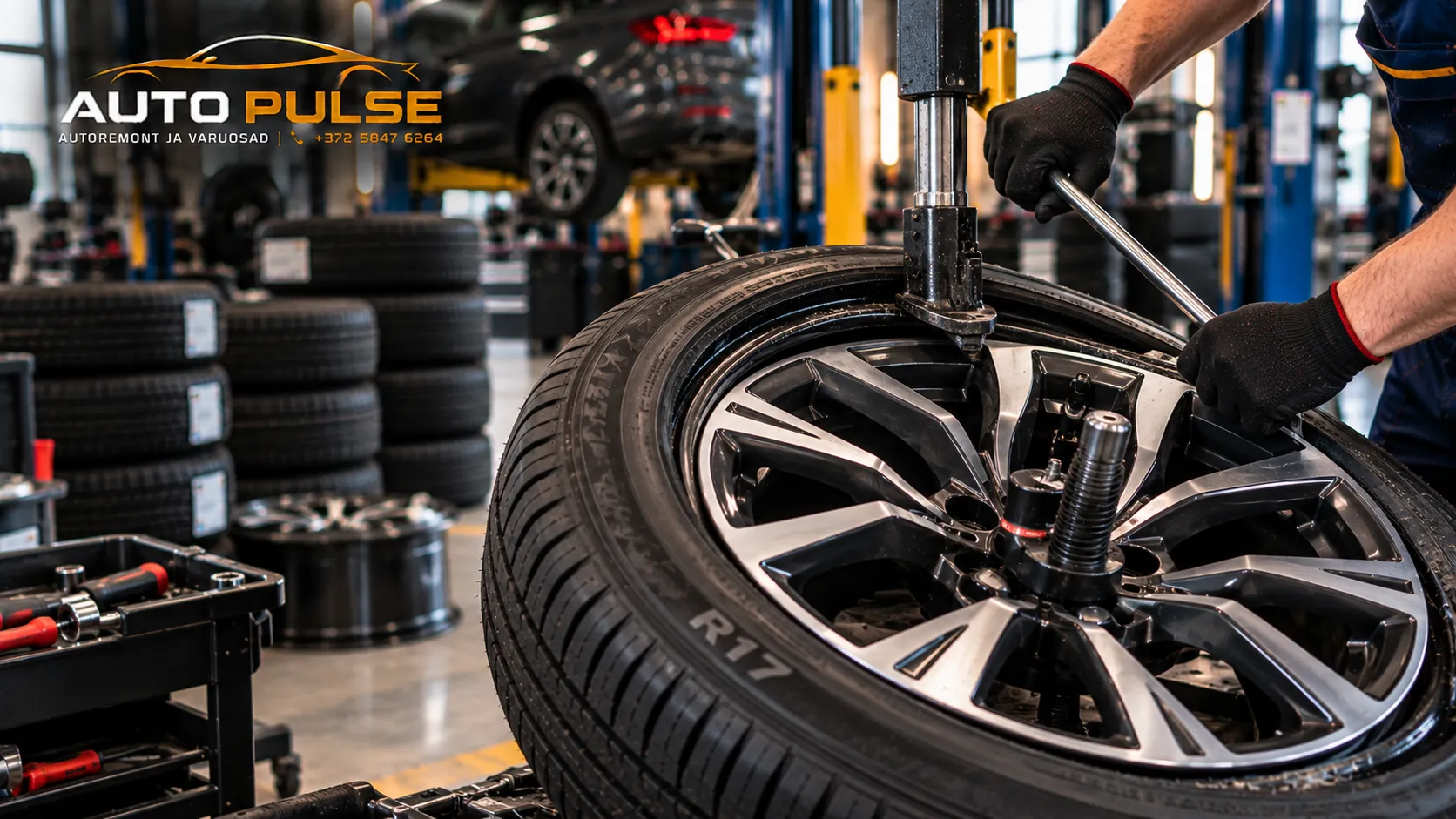
R17 wheel rims are widely used among cars that are commonly seen on the roads of Tallinn. This size is used by owners of Volkswagen Passat, Audi A4, BMW 3 Series, Škoda Octavia, Toyota RAV4, and many other models.
Before the seasonal tire change, drivers naturally ask: how much does it cost to replace R17 tires in Tallinn, and what services are included in the price?
The price depends not only on the rim diameter but also on the vehicle type, tire construction, and the selected service.
For example, a seasonal swap of complete wheels mounted on rims and a full tire mounting service with remounting are two different procedures.
In this article, specialists at Auto Pulse explain how the cost of R17 tire mounting is determined, what features low-profile tires and RunFlat tires have, and how to prepare for your visit to the auto service center.
How Much Does R17 Tire Mounting Cost in Tallinn in 2026?
The cost of replacing R17 tires primarily depends on the scope of work.
If you have two sets of wheels on separate rims, a seasonal swap is sufficient.
If summer and winter tires are used with one set of rims, a full tire mounting service will be required.
Seasonal Swap of Complete R17 Wheels
This option is suitable for drivers who already have their summer and winter tires mounted on separate rims.
The technician does not need to remove the tires from the rims.
The procedure includes:
- Lifting the car.
- Removing the installed wheels.
- Checking the condition of the fastening elements.
- Installing the second set of wheels.
- Checking tire pressure.
- Tightening the fasteners to the torque recommended by the vehicle manufacturer.
Wheel balancing can be performed additionally if needed.
The estimated cost for swapping four R17 wheels seasonally with balancing is €36–70.
The actual price depends on the vehicle type and the specific services chosen.
The average duration of this procedure is about 30–45 minutes.
If the wheels require additional balancing, cleaning, or other operations, the service may take longer.
Full R17 Tire Mounting with Remounting and Balancing
If your car has only one set of rims and you need to switch from summer to winter tires or vice versa, a full remounting procedure is required.
The procedure includes:
- Removing the wheels from the car.
- Taking the old tires off the rims.
- Inspecting the rims and mounting surfaces.
- Checking the condition of the valves.
- Mounting the new set of tires.
- Inflating the wheels to the recommended pressure.
- Balancing.
- Installing the wheels back onto the car.
The initial price estimate provided is €35–48 per R17 set.
However, this amount should be verified against Auto Pulse’s current price list: depending on the scope of work, full remounting may cost more than a seasonal swap of complete wheels.
We recommend checking the final cost of the specific service before booking.
R17 Tire Replacement Price Table
| Service | Estimated Cost for 4 Wheels |
| Seasonal swap of complete R17 wheels with balancing | €36–70 |
| Full R17 tire mounting with remounting and balancing | €35–48* |
| Low-profile R17 tire mounting | On request |
| RunFlat R17 tire mounting | On request |
| Additional valve or TPMS services | As agreed |
Prices are taken from the provided material and have not been confirmed against Auto Pulse’s current price list. They must be checked before publication, especially the range for full remounting.
To learn more about the cost of servicing wheels of other sizes, read the article “How Much Does Tire Service Cost in Tallinn?”.
Why Can R17 Tire Mounting Costs Vary?
Even if two vehicles are equipped with rims of the same diameter, the cost of servicing them may differ.
The reason lies in tire construction, vehicle characteristics, and the condition of the wheels.
1. Low-Profile R17 Tires
Many modern cars use low-profile tires.
One common size is 225/45 R17.
Such tires have a relatively small sidewall height, which affects mounting specifics.
When working with low-profile tires, consider the following:
- sidewall stiffness;
- tire-to-rim seating characteristics;
- risk of damaging the rim edge;
- need for appropriate mounting tools;
- correct use of mounting paste.
Careless handling may damage the rim coating or the tire bead.
Therefore, it is important that tire mounting is performed on suitable equipment while strictly following technology guidelines.
2. RunFlat R17 Tires
RunFlat technology is used in some BMW, Mercedes-Benz, and other manufacturers’ vehicles.
The feature of such tires is their reinforced sidewall construction.
In case of pressure loss, they may allow continued driving over a limited distance at reduced speed, if permitted by the tire and vehicle manufacturers.
However, RunFlat tires require extra attention during mounting.
The reinforced sidewall makes removal and installation more difficult, so special equipment or additional tools may be needed.
The cost of RunFlat R17 tire mounting may be higher than standard.
If your vehicle has such tires, please inform us when booking.
3. Vehicle Type
R17 diameter is found both on passenger cars and crossovers.
For example:
- Volkswagen Golf;
- Volkswagen Passat;
- Audi A3 and A4;
- BMW 3 Series;
- Škoda Octavia;
- Toyota RAV4;
- Nissan Qashqai.
At the same time, wheel size and weight can vary significantly.
Wide crossover tires sometimes require more time for mounting and balancing than standard passenger car wheels.
Therefore, when calculating costs, not only the rim diameter but also the vehicle category is taken into account.
4. Rim Condition
During seasonal tire changes, the technician may notice:
- dirt on the mounting surface;
- signs of corrosion;
- rim deformation;
- valve damage;
- remnants of old balancing weights;
- paintwork damage.
Some of these issues require additional processing or diagnostics.
For instance, corrosion on the mounting surface can compromise the seal between the tire and the rim.
A deformed rim may cause vibrations even after balancing.
In such cases, the root cause must first be identified.
Additional Services During R17 Tire Replacement
Beyond standard remounting, additional work may sometimes be necessary.
The need for these services depends on the condition of the specific wheel set.
Valve Replacement
The valve ensures the wheel’s airtightness.
Over time, rubber components may lose elasticity due to temperature fluctuations, moisture, and road chemicals.
It is recommended to check the valve condition during every remounting.
If cracks, damage, or signs of air leakage are found, the valve must be replaced.
This helps prevent gradual pressure loss after tire mounting.
TPMS Pressure Sensor Maintenance
Many modern cars use a Tire Pressure Monitoring System (TPMS).
Depending on the vehicle design, it may operate using individual sensors inside the wheels or rely on data from other vehicle systems.
If internal sensors are present, caution must be exercised during tire removal.
Damaging a sensor can lead to errors in the pressure monitoring system.
In some cases, replacement of sealing elements or the valve service kit is required.
Note that batteries in most factory-installed internal TPMS sensors cannot be replaced separately; when depleted, the entire sensor is usually replaced.
Wheel Balancing
Balancing is necessary after removing and remounting a tire onto a rim.
During the procedure, a specialized machine detects wheel imbalance.
The technician installs balancing weights at calculated positions.
Proper balancing helps reduce vibrations and ensures smooth wheel operation.
If the rim is physically deformed, balancing alone is insufficient.
Seasonal Storage of R17 Tires
After the seasonal swap, the removed set must be stored correctly.
To preserve the rubber’s condition, it is recommended to:
- clean the tires from heavy dirt;
- store them away from direct sunlight;
- avoid contact with oils and chemicals;
- choose a dry place with moderate temperature;
- follow the manufacturer’s recommendations regarding tire storage position.
The storage method depends on whether the tires are mounted on rims or not.
Proper conditions help reduce the risk of premature rubber aging.
How to Save on R17 Tire Mounting Without Compromising Quality?
Savings on seasonal tire changes should never come at the expense of safety.
However, there are several ways to reduce costs.
Use Two Sets of Rims
If you regularly switch between summer and winter tires, having separate sets of rims can be a convenient solution.
In this case, no remounting is needed during each seasonal swap.
Advantages include:
- fewer mounting operations;
- faster seasonal swaps;
- convenience of storing assembled wheels;
- potential reduction in regular maintenance costs.
However, before purchasing a second set of rims, consider its cost.
Book in Advance
In spring and autumn, demand for tire mounting in Tallinn increases noticeably.
Periods of sudden weather changes are particularly busy.
Booking in advance makes it easier to choose a convenient time and avoid searching for an available auto service center at the last minute.
You can read about seasonal change timing in the article “When to Change Winter Tires to Summer Tires in Estonia”.
Check Wheel Condition Before Your Visit
Before tire mounting, it is recommended to inspect the tires and rims.
Pay attention to:
- cuts;
- sidewall bulges;
- cracks;
- uneven wear;
- rim deformation;
- pressure loss.
If you notice any problems, report them when booking.
This allows the technician to assess the need for additional work in advance.
Don’t Forget the Locking Nut Key
Some cars are equipped with special anti-theft wheel bolts.
A corresponding adapter key is required for their removal.
Usually, it is stored in the trunk, glove compartment, or original tool kit.
Without the proper key, wheel removal may be impossible.
Therefore, be sure to check its availability before visiting the auto service center.
How Long Does R17 Tire Mounting Take?
Service duration depends on the chosen option.
Seasonal swap of complete R17 wheels usually takes about 30–45 minutes.
Full remounting of an R17 set with balancing typically takes 40–60 minutes, assuming no additional work is needed.
For RunFlat tires, low-profile tires, or damaged wheels, the time may increase.
Fastener condition, vehicle specifics, and the need for additional checks also affect duration.
Therefore, we recommend clarifying the estimated work time when booking.
How to Book R17 Tire Replacement at Auto Pulse?
If you need R17 tire mounting in Tallinn, you can contact Auto Pulse.
When booking, please specify:
- Car make and model.
- Tire size — e.g., 225/45 R17.
- Required service: seasonal swap of complete wheels or full remounting.
- Presence of RunFlat tires, if applicable.
- Any additional wheel problems, if present.
This information helps determine the scope of work and provide a preliminary cost estimate.
Frequently Asked Questions (FAQ)
How Much Does Replacing Four R17 Tires Cost in Tallinn?
The provided material indicates estimates of €36–70 for a seasonal swap of complete wheels with balancing and €35–48 for full remounting.
These amounts must be verified against Auto Pulse’s current price list before publication, as pricing depends on service composition and wheel characteristics.
How Long Does Full R17 Tire Replacement Take?
Usually about 40–60 minutes for a set of four wheels.
If additional work is required, the duration may increase.
Does RunFlat Tire Type Affect Cost?
Yes.