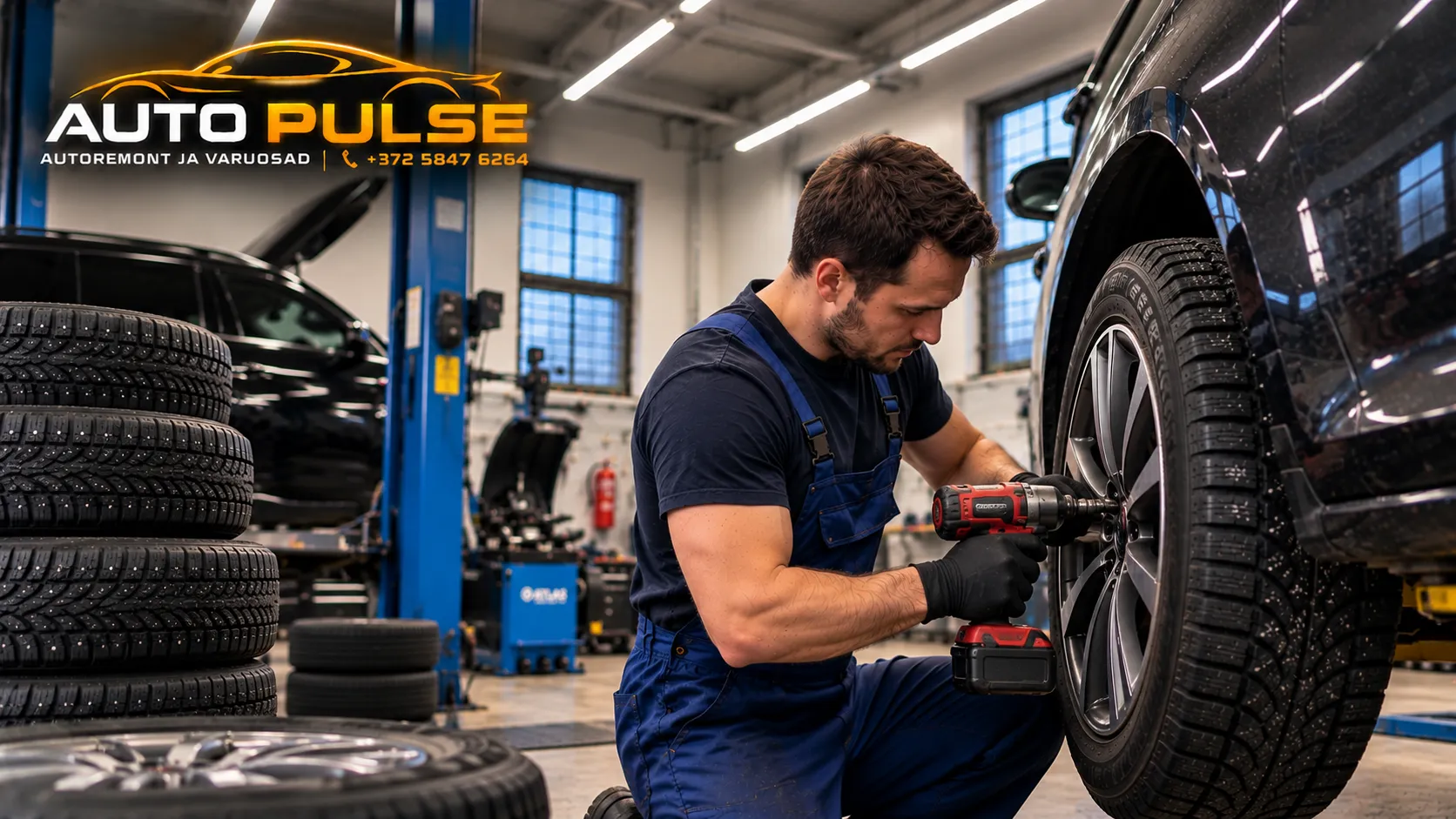
When to change summer tires to winter tires in Estonia? This question becomes especially relevant in October, when the air temperature begins to drop, rains become more frequent, and the first night frosts appear.
Many drivers in Tallinn postpone the seasonal change until the first snowfall. However, this approach can lead to two problems: decreased traffic safety and increased waiting times at tire fitting shops.
A practical guideline for switching to winter tires is a sustained temperature drop to around +5…+7 °C. However, the final decision must be made taking into account the weather forecast, road conditions, and the timing of daily trips.
In this article, the specialists at AutoPulse will explain when it is necessary to install winter tires according to Estonian legislation in 2026, why you should not wait for the first snow, and how to prepare your car for the winter season in advance.
Tire change rules and deadlines in Estonia: 2026 legislation
Estonia has established specific deadlines for the mandatory use of winter tires for passenger cars.
At the same time, it is necessary to distinguish between the mandatory winter period, the permitted periods for using studded tires, and the rules for operating non-studded winter tires.
When are winter tires mandatory by law?
The mandatory period for using winter tires in Estonia is from December 1 to March 1.
During this period, vehicles subject to this requirement must be equipped with suitable winter tires.
However, this does not mean that you need to wait until December 1.
If snow, black ice, or sustained frosts arrive earlier, it is recommended to switch to the winter set in advance.
When can studded tires be installed?
The following periods for the use of studded tires apply in Estonia:
- From October 15 to March 31 — the standard permitted period.
- From October 1 to April 30 — the extended period if winter road and weather conditions exist.
Thus, if necessary, studded tires can be installed as early as the beginning of October, if weather conditions require it.
At the same time, the standard permission begins on October 15.
It is important to consider the deadlines for using studded tires not only in autumn but also in spring.
Read more about this in our article “When to change winter tires to summer tires in Estonia”.
Can non-studded winter tires be used year-round?
Yes. Suitable non-studded winter tires can be used year-round, provided technical requirements are met.
However, their operation in hot weather may be accompanied by accelerated wear and a deterioration in some handling and braking characteristics.
Therefore, it is recommended to use high-quality summer tires for the summer season.
What is the minimum tread depth for winter tires?
During the mandatory winter period, the minimum allowable tread depth for winter tires is 3 mm.
For comparison, the legal minimum for summer tires is 1.6 mm.
However, 3 mm is the maximum allowable limit, not the recommended depth for starting the winter season.
For regular driving on snow and slush, it is recommended to consider replacing winter tires when the remaining tread depth is around 4–5 mm.
It is also important to check the winter tire markings. During the mandatory period, non-studded winter tires must meet winter certification requirements, including the 3PMSF marking — the three-peak mountain snowflake symbol.
Current technical requirements can be checked on the official website of the Estonian Transport Administration — Transpordiamet.
Why it is dangerous to wait for the first snow: 3 main risks
Waiting for the first snowfall might seem like a convenient solution, especially if autumn remains relatively warm.
However, weather conditions in Estonia can change very quickly.
Let us consider three main reasons why it is better to plan the seasonal change in advance.
1. Sudden temperature drop and reduced traction
Summer and winter tires differ in rubber compound composition, tread pattern, and design features.
Winter tires are designed for operation at low temperatures, on snow and ice.
Summer tires are intended primarily for the warm season.
The common +7 °C rule helps drivers navigate when planning a seasonal change; however, this does not mean that any summer tire instantly loses elasticity when this temperature is reached.
Characteristics depend on the specific model, surface temperature, and road conditions.
Using summer tires is especially dangerous when snow, black ice, or frozen moisture appears on the road.
Even if the daytime temperature is above freezing, ice can form early in the morning on bridges, overpasses, and shaded road sections.
Therefore, drivers who regularly travel early in the morning or late in the evening are advised to pay close attention to the weather forecast.
2. Queues at tire fitting shops in Tallinn
After the first snowfalls, demand for seasonal tire changes usually increases significantly.
Many car owners simultaneously start looking for available slots at auto service centers.
As a result, queues form, and convenient booking dates can quickly become unavailable.
If you plan the change in advance, you can:
- Choose a convenient time for your visit.
- Avoid the seasonal rush.
- Check the condition of your winter set.
- Purchase new tires in advance if necessary.
- Plan maintenance expenses.
- Prepare your vehicle before the weather deteriorates.
It is optimal to monitor the forecast for the next 7–10 days and book an appointment before the mass seasonal demand begins.
3. Increased risk of accidents on wet roads and the first black ice
The first black ice is especially dangerous because the driver may not always notice the change in road surface conditions in time.
A thin, transparent layer of ice, sometimes called “black ice,” can be practically invisible on the asphalt.
Summer tires are not designed for driving on such surfaces.
Winter models feature special tread elements and rubber compound compositions designed to improve traction in cold conditions.
At the same time, the braking distance depends on:
- Vehicle speed.
- Road surface condition.
- Tire type and model.
- Tread depth.
- Temperature.
- Brake system performance.
- Driver actions.
Therefore, it cannot be stated that at a temperature of around 0 °C, the braking distance on any summer tires always increases by a fixed 30–50%.
However, when driving on snow and ice, using suitable winter tires is of fundamental importance for safety.
When exactly should you book a tire fitting appointment?
For many drivers in Tallinn, the second half of October or November becomes a convenient time to switch to winter tires.
However, the specific date depends on the weather.
It is recommended to plan the seasonal change approximately 1–2 weeks before the expected sustained cold snap.
At the same time, it is important to consider not only the average daily temperature but also night frosts.
What signs should you look out for?
It is worth planning the change if:
- The temperature is steadily approaching +5…+7 °C.
- Night frosts are forecasted.
- Snow or wet snow is expected.
- Black ice appears on the roads.
- You regularly drive early in the morning.
- You have upcoming trips outside the city or to regions with colder weather.
If the winter set is already prepared, a pre-selected tire fitting date will help avoid rushing.
You can view available services in the “AutoPulse Tire Fitting” section.
What to check before changing tires?
Before visiting an auto service center, it is recommended to check the condition of the winter set.
This will allow you to determine in advance whether the tires are fit for use or if new ones need to be purchased.
1. Winter tire tread depth
The minimum allowable tread depth for winter tires during the mandatory winter period is 3 mm.
However, for confident driving on snow and slush, it is recommended to consider replacement when the remaining depth is around 4–5 mm.
It is best to measure the tread with a special depth gauge at several points.
If the wear is uneven, additional suspension diagnostics and wheel alignment checks may be required.
2. Valve condition
Rubber valves age over time and may lose their airtightness.
During seasonal maintenance, it is recommended to check:
- The presence of cracks.
- The condition of the seals.
- Airtightness.
- The absence of mechanical damage.
If necessary, the valve should be replaced.
For vehicles with TPMS pressure sensors, it is necessary to consider the design features and the manufacturer’s recommendations.
3. Need for balancing
Balancing allows compensating for the uneven distribution of wheel mass.
It helps reduce vibrations and ensure a more comfortable drive.
When mounting tires on rims, balancing is usually performed after installation.
If the wheels are changed as an assembly, the need for re-balancing depends on their condition and the presence of vibrations.
4. Rim condition
Before installing winter wheels, it is recommended to check the rims for:
- Deformations.
- Cracks.
- Severe corrosion.
- Damage to the seating surfaces.
- Signs of impacts.
Damaged rims can cause vibrations and airtightness issues.
5. Summer set storage
After the seasonal change, it is necessary to properly prepare the summer tires for storage.
It is recommended to clean them of dirt, dry them, and store them in a dry, cool room.
Tires must be protected from direct sunlight, heating appliances, and aggressive chemicals.
The storage method depends on whether the tires are stored on rims or separately.
If you do not have a suitable space, you can check the availability of seasonal storage services at an auto repair shop.
To calculate expenses in advance, we recommend reading the article “How much does tire fitting cost in Tallinn”.
Tire fitting services at AutoPulse: preparing your car for winter
Timely seasonal tire changes help prepare the vehicle for cold weather and difficult road conditions.
At AutoPulse in Tallinn, you can contact us for tire fitting and vehicle maintenance services.
During a seasonal change, it is important to pay attention to:
- Proper tire selection.
- Checking the tread condition.
- Inspecting sidewalls and rims.
- Wheel mounting.
- Balancing if necessary.
- Pressure checks.
- Compliance with the vehicle manufacturer’s requirements.
If vibrations, unusual noises appear after wheel installation, or the vehicle starts pulling to one side, it is recommended to undergo additional diagnostics.
The cause may be related to the wheels, suspension, wheel alignment, or other technical malfunctions.
You can learn more about the auto service center’s services on the official AutoPulse website.
Frequently Asked Questions (FAQ)
From what date can you drive on studded winter tires in Estonia?
The standard permitted period for using studded tires begins on October 15.
Under winter road and weather conditions, their use is permitted from October 1.
The standard period ends on March 31, and under winter conditions, use may continue until April 30.
What is the minimum winter tire tread depth according to Estonian law?
During the mandatory winter period, the minimum allowable tread depth for winter tires is 3 mm.
However, for driving on snow and slush, it is recommended to consider replacement when the remaining depth is around 4–5 mm.
Can you drive on summer tires in November?
Yes, the use of summer tires in November is not prohibited in itself for passenger cars, for which the mandatory winter period applies from December 1.
However, it is necessary to consider the actual road conditions.
If snow and black ice appear, continuing to drive on summer tires is dangerous.
What happens to insurance if you do not change tires on time and get into an accident?
Violating seasonal tire requirements may be a factor when considering an insurance claim.
However, this does not mean an automatic denial of payment or a mandatory recourse claim.
The consequences depend on the circumstances of the accident, the causal link between the violation and the crash, the type of insurance, and the applicable legislation.
Do you need to change tires at +7 °C?
A temperature of +7 °C is a common practical guideline, but not a legal requirement.
When choosing a date for the seasonal change, it is necessary to consider the weather forecast, road conditions, and the specifics of vehicle operation.
When is the best time to book a tire fitting appointment in Tallinn?
It is recommended to plan the change before the first sustained frosts and snowfalls.
For many drivers, this is October or November.
Booking in advance helps you choose a convenient time and avoid seasonal queues.
Prepare your car for winter with AutoPulse
Do not postpone the seasonal tire change until the first snowfall.
A timely switch to the winter set helps ensure suitable traction, braking, and handling characteristics in cold conditions.
Check the condition of your winter tires, tread depth, pressure, and wheel integrity.
If you are planning seasonal maintenance, contact AutoPulse.
AutoPulse — auto repair and spare parts in Tallinn.
Phone: +372 5847 6264
Website: https://autopulse.ee/