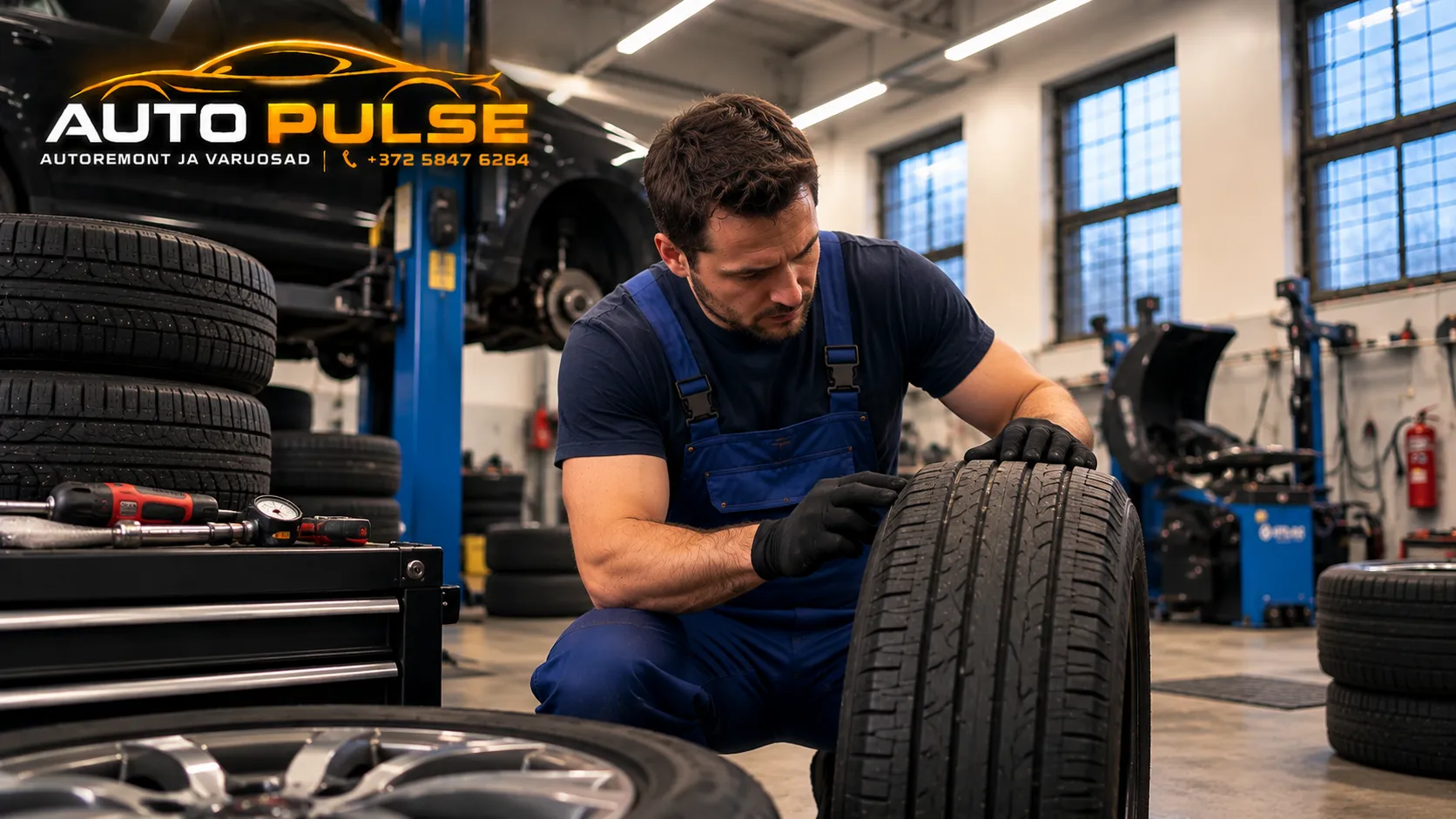
Autumn in Tallinn is a time when temperatures gradually drop, rain becomes more frequent, and the first night frosts appear. For car owners, this is a signal to check the condition of their summer tires and prepare for the winter season.
But how do you know that it’s time to replace your summer tires completely, rather than just storing them until next spring?
Even if tires have been used for only a few seasons, they may still be unsuitable for further use. Tread wear, sidewall damage, rubber compound aging, and uneven pattern wear all affect driving safety.
It is especially important to consider tire condition in Estonia, where autumn often brings wet asphalt, sharp temperature fluctuations, and black ice.
In this article, specialists from AutoPulse will discuss the five main signs of summer tire wear, Estonian legal requirements, and methods for self-inspecting your tires.
You will also learn when a tire can be repaired and when it must be replaced.
Seasonal factor: when to change tires in Estonia according to law and weather
When choosing the timing for seasonal tire replacement, two main factors must be considered: legal requirements and actual weather conditions.
When to switch from summer to winter tires?
In Estonia, the mandatory period for using winter tires on passenger cars lasts from December 1 to March 1.
Studded tires are generally permitted from October 15 to March 31, or from October 1 to April 30 during winter road and weather conditions.
However, relying solely on the calendar is not recommended.
The first frosts in Tallinn can occur significantly earlier than December.
A common practical guideline is to switch to winter tires when the average daily temperature consistently drops to approximately +5…+7 °C.
This is not a legally established temperature threshold but a recommendation for planning seasonal tire changes.
When selecting a date, consider the likelihood of snow and black ice, early morning temperatures, and road conditions on your usual routes.
Why shouldn’t you wait for the first snowfall?
Summer tires are designed primarily for use in warm weather.
On snow and ice, they do not provide the same grip characteristics as suitable winter models.
If you wait for the first snowfall, you may face not only dangerous road conditions but also increased demand for tire service.
Therefore, it is recommended to check the condition of your winter set in advance and choose a convenient time for service.
To plan your expenses, read the article “How much does tire service cost in Tallinn?”.
5 main signs that your summer tires are worn and need replacement
Even with low mileage, tires can become unfit for further use.
When assessing the condition of your set, pay attention to the following signs.
1. Critical tread depth and wear indicators
Tread depth is one of the most important indicators of a car tire’s condition.
In Estonia, the minimum allowable tread depth for summer tires is 1.6 mm.
However, this is a legal minimum, not an optimal value for safe driving on wet roads.
As the tread wears down, it removes water less effectively from the contact patch, increasing the risk of hydroplaning.
For regular travel on wet roads, it is recommended to consider replacing summer tires once the remaining tread depth reaches about 3 mm.
Special TWI (Tread Wear Indicator) markers help assess wear.
These are small protrusions inside the main tread grooves.
When the tread surface reaches the level of the standard 1.6 mm indicator, the tire is at its maximum allowable wear limit.
If the tread depth has reached the established minimum, further use must be stopped and the tire replaced.
2. Cracks, bulges, and rubber aging
Over time, the rubber compound gradually ages due to exposure to oxygen, ozone, sunlight, and temperature fluctuations.
Cracks may appear on the sidewalls and within the tread grooves.
Not all surface changes mean immediate unusability, but significant cracks require professional assessment.
Sidewall bulges, often called “hernias” by drivers, are particularly dangerous.
They may indicate damage to the tire’s internal structure after impact with potholes, curbs, or other obstacles.
Driving on a tire with a bulge is dangerous. Such damage can lead to sudden pressure loss and tire failure while moving.
If you detect a bulge, stop using the damaged tire and consult a specialist.
3. Uneven tread wear
If the tread wears more heavily on the inner or outer side, this may indicate technical issues with the vehicle.
Causes of uneven wear may include:
- Incorrect tire pressure.
- Misaligned wheel angles.
- Worn suspension components.
- Faulty shock absorbers.
- Wheel imbalance.
- Specific vehicle usage patterns.
Sometimes the tread develops a sawtooth pattern when adjacent blocks wear unevenly.
This type of wear may be accompanied by increased noise during driving.
If you simply install a new set without identifying the cause, the problem may recur.
Therefore, with pronounced uneven wear, it is recommended to check the suspension, tire pressure, and wheel alignment.
4. Damage to the tread and sidewalls
Not every tire damage requires replacement, but some defects make further use unsafe.
Pay attention to:
- Deep cuts.
- Visible cord damage.
- Bulges.
- Foreign metal objects in the tread.
- Signs of delamination.
- Damage to the tire bead.
- Poorly executed previous repairs.
Sidewalls should be inspected with particular care.
They constantly deform during driving, so damage in this area can pose a serious hazard.
If you find a deep cut or suspicious bulge, do not attempt to assess structural integrity yourself.
It is better to visit an auto service center for a professional inspection.
5. Age of car tires
Even if a car is rarely used, tires gradually age.
The rate of aging depends on storage conditions, temperature, sun exposure, and usage patterns.
The production date is usually indicated on the sidewall as four digits.
For example, the marking 3520 means the tire was manufactured in the 35th week of 2020.
After several years of use, it is recommended to inspect the rubber condition carefully and follow manufacturer guidelines.
There is no universal rule requiring automatic replacement of all tires after 5–6 years.
Age is an important factor, but the final decision depends on the tire’s condition and manufacturer requirements.
How to self-inspect tire condition before removal
Before sending summer wheels into storage, it is useful to perform a basic inspection.
This will help determine in advance whether the set can be used next season.
Using a tread depth gauge
The most accurate and convenient method is a specialized mechanical or digital gauge.
Inspection procedure:
- Park the car on a level surface.
- Select a main tread groove.
- Insert the measuring probe into the groove.
- Read the measurement in millimeters.
- Repeat measurements at several points.
- Compare values across the center and edges of the tread.
If wear varies significantly across the tire width, additional vehicle technical checks are recommended.
For approximate assessment, a coin is sometimes used, but this method lacks precision for determining compliance with legal standards.
Visual sidewall inspection
Inspect tires under good lighting.
Check for:
- Cracks.
- Bulges.
- Cuts.
- Impact marks.
- Deformations.
- Condition of previously repaired areas.
Also check the condition of valves and rims.
If a tire regularly loses pressure, identify the leak source.
It may be caused by punctures, valve damage, rim corrosion, or compromised sealing surfaces.
Can tires be saved: when repair suffices vs. when replacement is needed
Not every damage requires buying a new set.
In some cases, tires can be safely repaired.
When is repair possible?
Repair is typically considered if:
- The puncture is in the repairable central tread zone.
- Damage size falls within repair technology limits.
- The tire’s internal structure is undamaged.
- The tire has not been driven on while deflated.
- Repair follows proper technology and manufacturer recommendations.
For some passenger tires, standard repair procedures allow punctures up to 6 mm diameter in designated repair zones, though this is not a universal rule for all tires.
A specialist must inspect the inner surface to determine repair feasibility.
When must a tire be replaced?
Replacement is usually required for these damages:
- Sidewall bulge.
- Severe sidewall cut.
- Internal carcass damage.
- Tread delamination.
- Pronounced aging cracks.
- Damage from driving on underinflated or flat tires.
- Wear to maximum allowable depth.
Repairability decisions must be made after specialist inspection.
Do not continue using a damaged tire merely because it still holds air.
Preparing summer tires for storage: AutoPulse tips
If summer tires are in good condition, they can be prepared for next season.
Proper storage helps slow rubber aging and prevent undesirable deformation.
1. Washing and drying
Before storage, remove road dirt, salt, and other contaminants from tires and rims.
Allow wheels to dry completely after cleaning.
Avoid aggressive chemicals that may damage rubber.
2. Wheel labeling
Before removal, mark each wheel’s position on the vehicle.
For example:
- LF — left front.
- RF — right front.
- LR — left rear.
- RR — right rear.
This labeling helps track usage history and plan wheel rotation.
During next installation, consider tire rotation direction, construction type, and vehicle manufacturer recommendations.
3. Packaging
Use special covers or protective bags for storage.
Ensure tires are clean and dry.
Packaging should protect against contamination and adverse external effects.
4. Storage conditions
Store tires in a room protected from:
- Direct sunlight.
- High temperatures.
- Excess humidity.
- Oils and solvents.
- Ozone sources.
- Mechanical damage.
Choose a dry, cool, and clean space optimally.
5. Proper positioning
Placement method depends on whether tires are stored with or without rims.
Tires on rims can be stored horizontally stacked or hung by rims if storage conditions permit.
Tires without rims are usually recommended to be stored vertically on a suitable surface.
Periodically adjust their position according to manufacturer recommendations.
Before next-season installation, recheck tire condition thoroughly.
Frequently Asked Questions (FAQ)
What is the minimum remaining tread depth for summer tires in Estonia?
The minimum allowable tread depth for summer tires is 1.6 mm.
However, to maintain safety margins on wet roads, consider replacement once depth reaches about 3 mm.
Can I drive on summer tires after October 15 if there is no snow?
Yes. The arrival of October 15 alone does not mandate switching to winter tires.
For vehicles subject to seasonal requirements, the mandatory winter period begins December 1.
However, if frosts, snow, or black ice appear, account for real road conditions and do not delay replacement.
How many years can summer tires be safely used?
There is no universal lifespan identical for all tires.
Some manufacturers recommend thorough inspections after several years of use and set maximum service life, often around 10 years from production date.
Damaged or heavily worn tires must be replaced regardless of age.
Can summer tires with 2 mm tread depth be used?
If the tire meets other technical requirements, 2 mm depth exceeds the legal minimum of 1.6 mm.
However, safety margin on wet roads is already limited.
Consider replacing the set before next season.
Must all four tires be replaced simultaneously?
Not always.
Decision depends on wear extent, drive type, vehicle construction, and manufacturer recommendations.
Adhere to requirements for tire sizing, specifications, and compatibility.
When replacing only two tires, installing the better-grip set on the rear axle is often recommended unless otherwise specified by the vehicle manufacturer.
Check summer tires before next season at AutoPulse
Car tire condition directly affects driving safety.
If tread approaches minimum allowable depth, cracks, bulges, or uneven wear appear, do not postpone inspection.
At AutoPulse in Tallinn, you can address seasonal tire changes and vehicle maintenance.
Timely tire service and proper pre-storage preparation help avoid extra costs and unpleasant surprises next season.
AutoPulse — auto repair and parts in Tallinn.
Phone: +372 5847 6264
Website: https://autopulse.ee/