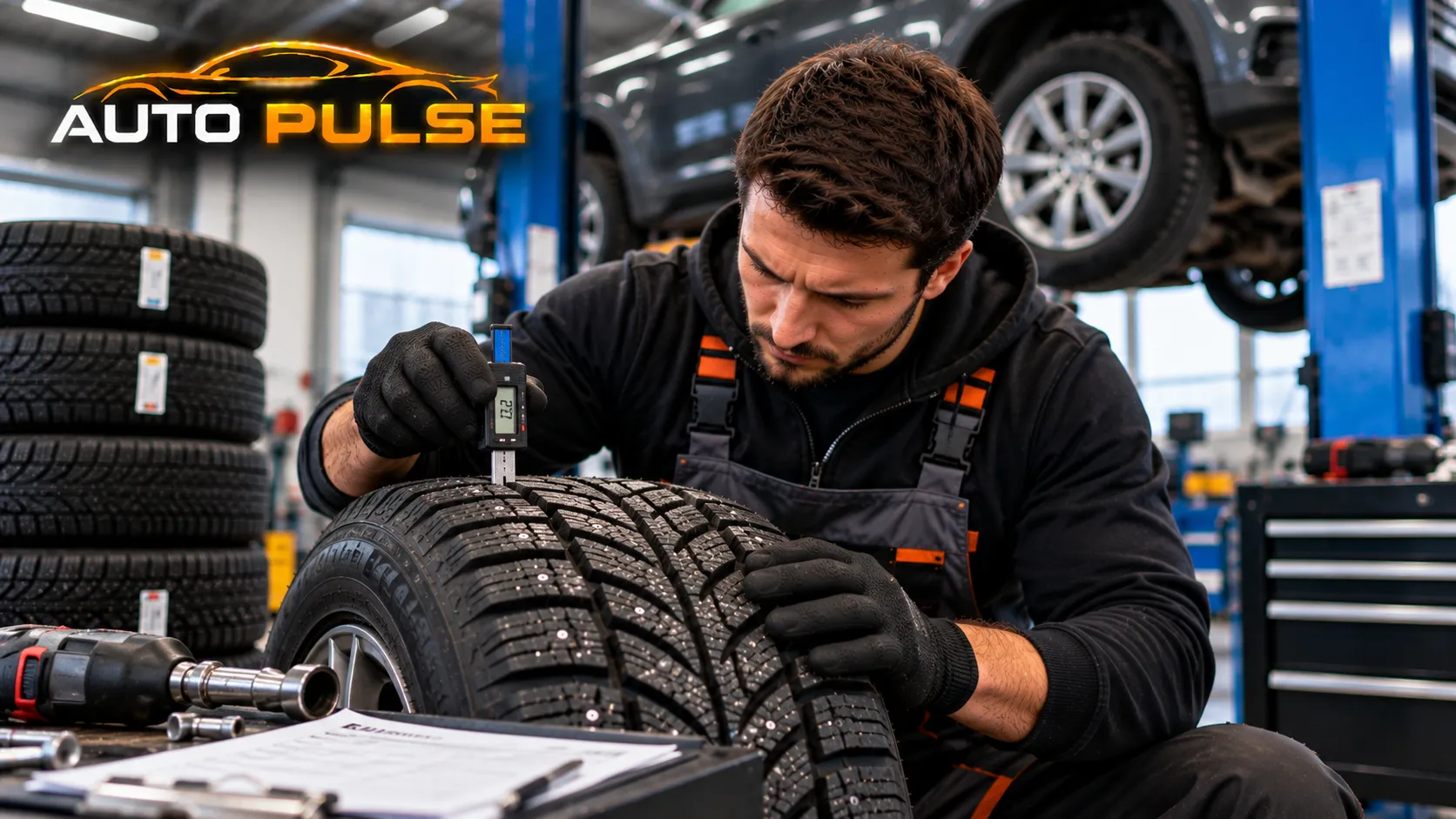
Seasonal tire changes in Estonia are an important part of preparing your vehicle for changing weather conditions. Many drivers try to book their tire service appointment on time but forget to check the condition of the set they intend to install.
Meanwhile, even properly selected winter or summer tires can become unsafe due to wear, damage, or rubber aging.
How to inspect tires yourself before installation? What tread depth should you aim for? How do you determine the age of tires using the DOT marking, and which damages require mandatory inspection by a specialist?
In this guide, specialists at Auto Pulse have compiled a step-by-step checklist to help you assess the condition of your wheels before visiting the auto service.
If you are still planning your seasonal changeover, read the article “When to Change Winter Tires to Summer Tires in Estonia”.
Why It Is Important to Check Tires Before Tire Service
A preliminary inspection helps detect problems in time and avoid unnecessary expenses.
For example, if a tire has sidewall damage or critical tread wear, installing it on the vehicle may be unsafe.
Checking before mounting allows you to:
- Detect cracks, cuts, and bulges.
- Determine the remaining tread depth.
- Check the age of the tires.
- Identify uneven wear.
- Assess the condition of rims and valves.
- Decide in advance about repair or replacement.
This is especially important in Estonia, where drivers regularly encounter rain, snow, slush, and black ice.
Worn tread drains water less effectively, and structural tire damage can create additional risks while driving.
Checking tires before installation takes little time but helps avoid a repeat visit to the tire shop and unforeseen problems on the road.
How to Check Tires Before Installation: Step-by-Step Instructions
For the initial inspection, you will need good lighting, a tread depth gauge, and a few minutes of free time.
It is advisable to check all four tires, even if the set was used for only one season.
Step 1. Measure the Tread Depth
Tread depth is one of the main indicators of tire usability.
In Estonia, the following minimum values apply to standard passenger cars:
- Summer tires — 1.6 mm.
- Winter tires during the mandatory winter period — 3 mm.
However, the minimum permissible depth does not always ensure good grip performance.
For summer tires, it is recommended to consider replacement when the remaining depth is around 3 mm, especially if you often drive on wet roads.
For winter tires, a practical guideline for replacement is a depth of about 4–5 mm, since sufficient tread is particularly important on snow and slush.
How to Correctly Measure Tread Depth
- Take a special tread depth gauge.
- Place it into the main tread groove.
- Measure the depth at several points around the circumference of the tire.
- Repeat measurements in different zones across the width of the tread.
- Compare the results and pay attention to uneven wear.
For accurate checking, it is better to use a gauge rather than a coin.
A coin can give an approximate idea of wear, but its size does not allow reliable determination of compliance with the established minimum.
If the tread is close to the minimum permissible depth, it is better to plan replacement in advance without waiting for grip deterioration.
Step 2. Check Tire Age via DOT Marking
Even if the car drives little, rubber compounds gradually age.
Storage conditions, temperature, sun exposure, and usage specifics affect the rate of aging.
The manufacturing date of a tire is usually indicated by four digits at the end of the DOT identification code.
The first two digits indicate the week of production, and the last two indicate the year.
For example:
- 3523 — 35th week of 2023.
- 1224 — 12th week of 2024.
- 4022 — 40th week of 2022.
The full code with the manufacturing date may be located only on one sidewall of the tire.
When Does Tire Age Become a Reason for Inspection?
There is no single deadline after which any tire automatically becomes unusable.
You must consider its actual condition and manufacturer recommendations.
Some manufacturers recommend conducting particularly careful inspections of tires after five years of use and replacing them no later than ten years from the date of manufacture.
At the same time, a damaged or improperly stored tire may require replacement much earlier.
Tire age must be assessed together with the condition of the tread, sidewalls, and carcass.
Step 3. Inspect Sidewalls and Tread for Damage
The next stage is a thorough visual inspection.
Check both the outer and inner sides of each tire.
Pay special attention to the sidewalls, shoulder areas, and the place where the tire connects to the rim.
Cracks on the Sidewall
Small surface cracks may be a sign of rubber aging.
Their danger depends on depth, location, and the overall condition of the tire.
If cracks are numerous, deep, or accompanied by other damage, professional assessment is necessary.
Do not try to independently determine the suitability of such a tire based solely on a photo or appearance.
Bulges and “Hernias”
A bulge on the sidewall may indicate damage to the internal elements of the tire structure.
It often occurs after a strong impact with a pothole or curb.
A tire with a pronounced bulge cannot be installed for normal operation.
Such damage requires professional assessment and, as a rule, tire replacement.
Cuts and Punctures
Inspect the tread for the presence of:
- Nails.
- Screws.
- Glass.
- Deep cuts.
- Signs of previous repairs.
- Damage to the shoulder area and sidewall.
Not every puncture means the necessity of buying a new tire.
Some damages in the repairable zone of the tread can be eliminated professionally.
However, damage to the sidewall and carcass may make further operation unacceptable.
If you discover a suspicious defect, seek diagnostics and clarify the possibility of repair.
Step 4. Check Valves and Wheel Rims
Even a functional tire will not reliably hold pressure if the valve is damaged or the seal against the rim is compromised.
Valve Inspection
Rubber valves age over time and may lose their seal.
During inspection, pay attention to:
- Cracks.
- Deformation.
- Signs of damage.
- Absence of a protective cap.
- Signs of air leakage.
When removing a tire from the rim, it is recommended to assess the valve’s condition and replace it if necessary.
For vehicles with TPMS (Tire Pressure Monitoring System), it is also important to check the condition of sensors, seals, and service elements.
Not all sensors require complete replacement with every seasonal remounting.
Rim Inspection
Inspect the wheel rim.
Check for the presence of:
- Dents.
- Cracks.
- Severe corrosion.
- Damage to the seating surface.
- Signs of impacts against curbs.
A deformed rim can cause vibrations and sealing issues.
If there is suspicion of damage, it is recommended to check the rim before installing the tire.
Uneven Tire Wear: Causes and Solutions
The pattern of tread wear can tell a lot about the vehicle’s condition.
However, an exact diagnosis cannot be made based solely on the wear pattern.
Causes must be confirmed by checking pressure, suspension, wheels, and alignment angles.
Center Tread Wear
If the central part of the tread is worn more than the edges, one possible cause is prolonged operation with increased pressure.
What to do: Check the recommended pressure for the vehicle and evaluate other possible causes of wear.
Wear on Both Edges
Accelerated wear of the shoulder areas may be related to insufficient pressure.
Loads, driving style, and tire design features must also be considered.
What to do: Check pressure, wheel tightness, and tire condition.
One-Sided Wear
If the inner or outer side of the tread is noticeably worn more than the other, violations in wheel alignment angles or suspension faults are possible.
What to do: Perform diagnostics and, if necessary, check wheel alignment.
Spot or Cupping Wear
Uneven wear patches around the circumference may be related to shock absorber issues, suspension problems, balancing errors, or other factors.
What to do: Check the condition of the running gear and wheels.
If the cause of uneven wear is not eliminated, a new set may also begin to wear incorrectly.
When Self-Inspection Is Not Enough
Visual inspection helps identify obvious defects but does not allow assessing all internal tire damage.
Professional diagnostics is especially important in the following cases:
- A bulge is detected on the sidewall.
- There are deep cuts or numerous cracks.
- The tire was operated with significantly reduced pressure.
- The wheel suffered a strong impact.
- Vibrations appeared after the previous season.
- The tread is worn unevenly.
- There are suspicions of rim damage.
- The tires are quite old.
- The quality of the previous puncture repair is unknown.
Operating a tire after prolonged driving in a deflated state is particularly dangerous.
Even if it looks normal from the outside, there may be carcass damage inside.
Do not install a doubtful tire just to save money on a new set.
At Auto Pulse in Tallinn, you can inquire about tire services and wheel condition assessment before seasonal replacement.
Pre-Installation Checklist for Winter or Summer Tires
Before visiting the tire shop, check the following items:
- Tread depth: meets seasonal requirements and has sufficient margin.
- Tire age: manufacturing date is known, condition matches manufacturer recommendations.
- Sidewalls: no dangerous cuts, bulges, or pronounced cracks.
- Tread: no suspicious damage or foreign objects.
- Wear: no pronounced unevenness.
- Rims: no visible deformation or damage.
- Valves: no cracks or signs of leakage.
- Size: complies with vehicle manufacturer requirements.
- Compatibility: tires on one axle meet technical requirements.
- Winter marking: for regular non-studded winter tires during the mandatory winter period, 3PMSF is present.
If at least one item raises doubts, it is better to check the set before installation.
Frequently Asked Questions (FAQ)
Can You Drive with Cracks on the Sidewall?
It depends on the nature of the damage.
Surface signs of aging require assessment, while deep cracks, cord damage, and pronounced deformations may render the tire unusable.
Professional inspection is required if there are doubts.
Is It Mandatory to Replace Valves During Seasonal Tire Changes?
When removing a tire from the rim, it is recommended to check the condition of rubber valves and replace them according to manufacturer recommendations and component condition.
Metal valves and TPMS systems have specific maintenance considerations.
If wheels are changed as assemblies without tire removal, automatic replacement of all valves is usually not required.
What to Do If Tread Depth Is Close to the Minimum?
It is better to plan replacement in advance.
For summer tires in Estonia, the minimum depth is 1.6 mm, and for winter tires during the mandatory winter period — 3 mm.
However, grip characteristics may deteriorate significantly even before reaching these values.
Can You Use Winter Tires with M+S Marking Without 3PMSF?
For regular non-studded winter tires during the mandatory winter period in Estonia, 3PMSF marking is required.
An M+S inscription alone is not enough.
Separate requirements apply to studded tires.
Do You Need Balancing Before Installing Tires?
If the tire is removed from the rim and reinstalled, balancing is usually performed after mounting.
If wheels are stored as assemblies, the need for rebalancing depends on wheel condition and the presence of vibrations.
Can Tire Suitability Be Determined by Age Alone?
No.
The manufacturing date is an important indicator, but the final decision depends on tire condition, storage conditions, usage, and manufacturer recommendations.
Check Your Tires Before Seasonal Replacement at Auto Pulse
Checking tires before installation helps timely identify wear, damage, and other problems that may affect vehicle safety.
Do not limit yourself to tread depth alone.
Inspect the sidewalls, check the manufacturing date, and assess the condition of rims and valves.
If suspicious damage is found, seek professional diagnostics.
Auto Pulse in Tallinn will assist with questions regarding seasonal tire service and vehicle maintenance.
Auto Pulse — auto repair and parts in Tallinn.
Phone: +372 5847 6264
Website: https://autopulse.ee/