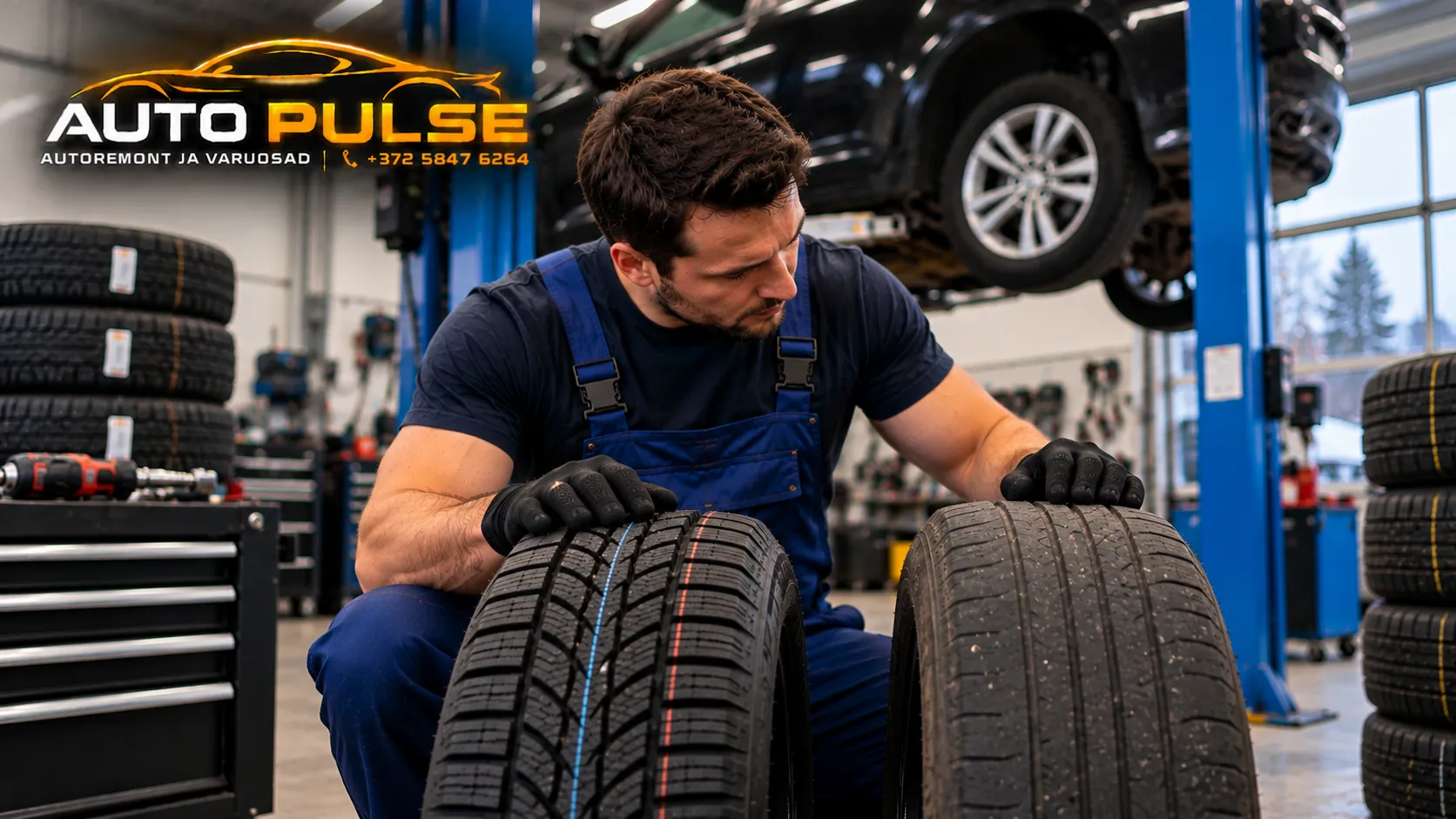
Is it possible to replace only two tyres instead of four in Estonia? Yes, in most cases this is acceptable, provided the remaining tyres are in good condition and the installed set meets the vehicle’s technical requirements and legal regulations.
Many drivers in Tallinn face a situation where one or two tyres wear out faster than the others. Buying a full set of four new tyres can be expensive, which creates a desire to replace only the damaged or worn pair.
However, such a decision requires careful attention to the tread condition, tyre construction, vehicle drivetrain type, and the manufacturer’s recommendations.
An incorrect combination of tyres can worsen handling, increase the risk of losing grip on wet roads, and in some cases, create additional strain on transmission components.
In this article, the specialists at AutoPulse will explain when you can replace just two tyres, where it is best to install the new pair, what difference in tread depth is acceptable, and in which situations all four wheels must be replaced.
What Estonian regulations say about replacing two tyres
Estonian legislation establishes requirements for the technical condition of vehicle tyres.
At the same time, there is no general requirement to replace all four tyres simultaneously.
A driver may replace only two tyres if the installed set complies with the applicable technical requirements.
Basic requirements for vehicle tyres
When selecting tyres, it is necessary to consider:
- Size dimensions.
- Construction.
- Permissible load.
- Speed ratings.
- Vehicle compatibility.
- Tread type and pattern.
- Seasonal requirements.
- Residual tread depth.
Compatible tyres that meet the established requirements for construction and tread pattern must be used on the same axle.
For regular use, it is recommended to choose the same tyre model on a single axle, preferably with a comparable degree of wear.
This helps ensure predictable vehicle behavior during braking and maneuvering.
Minimum tread depth in Estonia
The following basic values apply to passenger cars:
- Summer tyres — minimum 1.6 mm.
- Winter tyres during the mandatory winter period — minimum 3 mm.
However, these values are legal minimums, not optimal safety indicators.
For regular driving on wet asphalt, it is recommended to consider replacing summer tyres when the residual depth is around 3 mm.
For driving in snow and slush, it is recommended to consider replacing winter tyres when the depth is around 4–5 mm.
Current technical requirements can be checked on the official websites of Transpordiamet and Riigi Teataja.
For more details on seasonal rules, read the article “When to change winter tyres to summer tyres in Estonia”.
Why it is dangerous to improperly mix new and worn tyres
When replacing only part of a set, it is necessary to consider the difference in grip between the wheels.
A new tyre usually has a deeper tread than a previously used one.
On a wet road, this can affect the wheel’s ability to displace water and maintain contact with the asphalt.
Difference in grip
If tyres on the same axle differ significantly in condition, the vehicle may behave less predictably during braking or sudden maneuvers.
This is especially noticeable on:
- Wet asphalt.
- Slush.
- Packed snow.
- Roads with uneven surfaces.
- Areas with puddles and ruts.
A difference in grip between the left and right sides can affect the vehicle’s stability.
This is exactly why it is important not just to buy two new tyres, but to properly match them to the remaining set.
Impact on hydroplaning
Hydroplaning occurs when a layer of water forms between the tyre and the road surface.
At this point, the wheel partially or completely loses contact with the road.
The risk depends on speed, water depth, tyre construction, and tread condition.
If one tyre is significantly worn and the other is practically new, their behavior on a wet surface may differ.
This is especially dangerous at high speeds and during sudden maneuvers.
Additional strain on the transmission
Tread wear affects not only grip but also the effective rolling circumference of the wheel.
If the wheels differ significantly in size or wear, they may rotate at different speeds while the vehicle is in motion.
For certain transmission designs, this creates additional strain.
Particular care must be taken with all-wheel-drive vehicles.
Front or rear-wheel drive: where to install new tyres?
One of the most common questions when replacing only two tyres is which axle to install the new pair on.
Many drivers believe that new tyres must always be placed on the front, especially if the vehicle is front-wheel drive.
However, when replacing two tyres, leading manufacturers often recommend installing the pair with better grip on the rear axle, unless the vehicle manufacturer specifies otherwise.
Why is it recommended to put new tyres on the rear?
The rear axle plays a crucial role in vehicle stability.
If the rear wheels lose grip before the front ones, oversteer and skidding can occur.
On a wet road, such a skid can develop quickly and require complex corrective actions.
Installing tyres with better grip characteristics on the rear helps reduce the risk of losing rear axle stability.
What if the vehicle is front-wheel drive?
For many front-wheel-drive vehicles, the recommendation to install the better pair on the rear axle is also relevant.
Despite the front wheels being responsible for steering and power delivery, rear axle stability remains a crucial safety factor.
However, the final decision must be made taking into account the vehicle manufacturer’s recommendations and the characteristics of the specific tyre set.
What should rear-wheel-drive vehicle owners do?
For rear-wheel-drive vehicles, it is also important to ensure sufficient grip of the rear wheels.
At the same time, it is necessary to consider the tyre dimensions and the specific design features of the vehicle.
Some models use different sizes for the front and rear wheels.
In such cases, rotating tyres between axles may be impossible.
All-wheel drive AWD and 4WD: why the requirements are stricter
All-wheel-drive vehicles require special attention during partial tyre replacement.
Depending on the design of the AWD or 4WD system, a significant difference in the rolling circumference of the wheels can create additional strain on transmission components.
This applies to certain types of:
- Center differentials.
- All-wheel-drive engagement clutches.
- Transfer cases.
- Electronically controlled torque distribution systems.
Can you replace only two tyres on an all-wheel-drive vehicle?
Sometimes yes, but the decision depends on the manufacturer’s requirements.
For some vehicles, the permissible difference between tyres is very small.
The manufacturer may set limits on tread depth, rolling circumference, or other parameters.
There is no universal value of 2–3 mm that applies to all all-wheel-drive vehicles.
Before replacing only two tyres on an all-wheel-drive vehicle, it is necessary to check the manufacturer’s manual.
If the remaining wheels are significantly worn, replacing the entire set may be required.
What tread depth difference is acceptable on the same axle?
Tread depth is one of the important indicators of tyre compatibility.
However, it is necessary to distinguish between legal requirements and technical recommendations.
Is there a legally established limit of 2 mm?
A 2 mm difference should not be considered a universal legal limit for all vehicles in Estonia.
The acceptability of combining tyres is determined by applicable technical requirements, vehicle design, and manufacturer recommendations.
In practice, it is recommended to aim for minimal wear difference between tyres on the same axle.
Why is it important to measure both tyres?
Suppose one tyre has a tread depth of 7 mm, and the second has 3 mm.
Even if both formally meet the minimum requirements for summer use, their performance on a wet road may differ significantly.
Therefore, with a significant difference in wear, it is recommended to consider replacing both tyres on the axle.
How to properly measure tread depth?
For checking, it is best to use a specialized mechanical or digital depth gauge.
Measurement procedure:
- Park the vehicle on a level surface.
- Select the main tread grooves.
- Measure the depth in several places around the tyre’s circumference.
- Compare the values on the inner, central, and outer sections.
- Repeat the measurements on the second wheel.
- Assess the difference and the presence of uneven wear.
If the tread wears unevenly, it is recommended to check the pressure, suspension condition, and wheel alignment angles.
If only one tyre is damaged: buy one or two?
A puncture, sidewall cut, or damage from hitting a pothole may require replacing a single tyre.
However, buying a single new tyre is not always the optimal solution.
When can you replace only one tyre?
This option may be acceptable if:
- The second tyre on the same axle is practically new.
- An identical model of the appropriate size is available.
- The wear difference complies with the manufacturer’s requirements.
- The new tyre is compatible with the remaining set.
- There are no other technical restrictions.
At the same time, belonging to the same production batch is usually not a mandatory condition.
Far more important are the characteristics, construction, dimensions, and compatibility of the tyres.