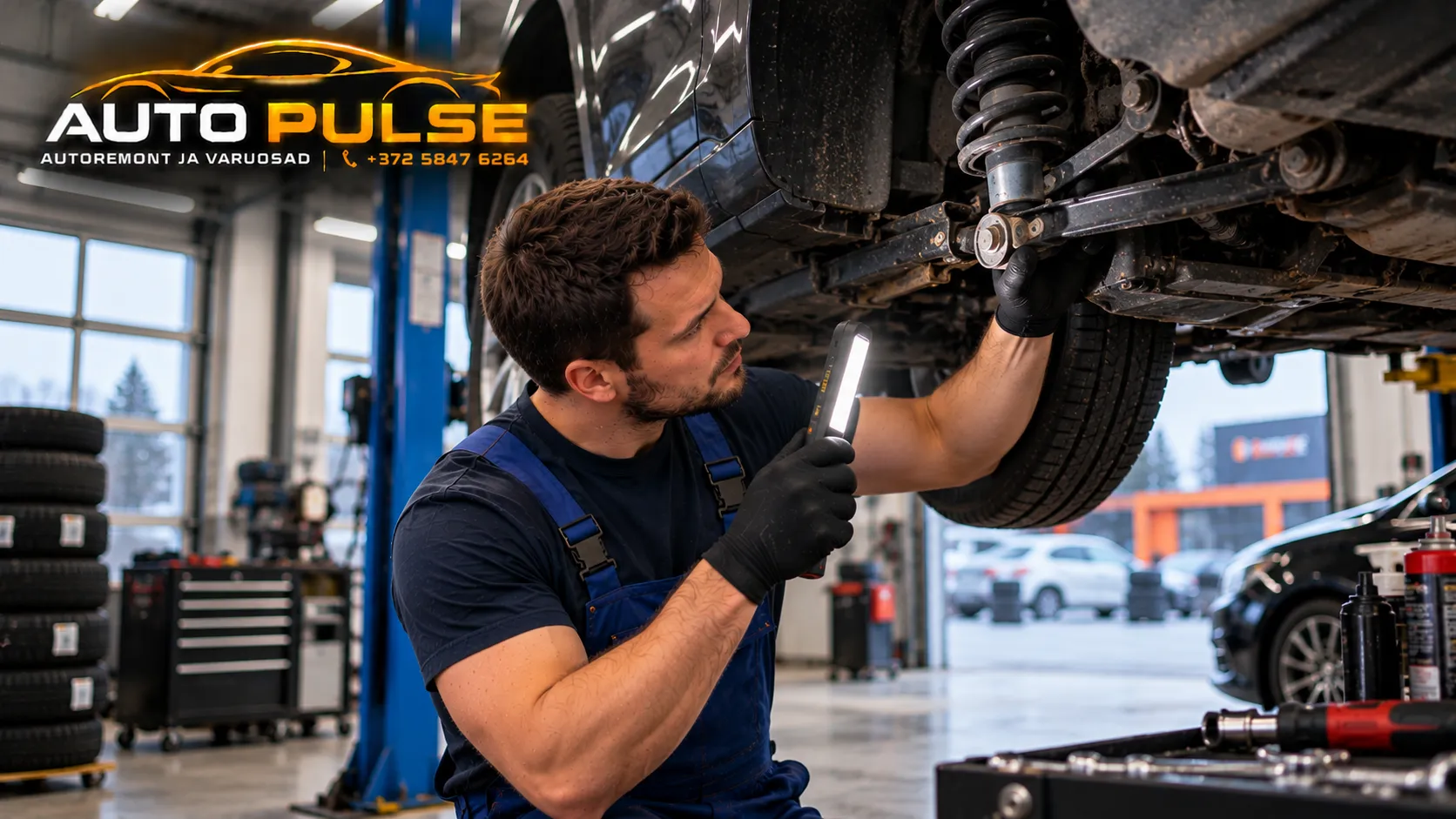
Spring in Estonia brings not only long daylight hours and above-freezing temperatures, but also new challenges for your vehicle. After several months of operation in snow, ice, high humidity, and road chemicals, the car requires additional attention.
Preparing your car for spring in Tallinn helps to detect malfunctions in a timely manner, reduce the risk of unexpected breakdowns, and extend the service life of key components.
It is especially important to check the suspension, braking system, tires, technical fluids, and the condition of the bodywork after the winter season.
The specialists at AutoPulse have prepared a detailed checklist that will help you independently assess the condition of your vehicle and determine which tasks are best left to auto service professionals.
Why spring maintenance is important after an Estonian winter
Winter vehicle operation in Estonia is accompanied by several factors that can accelerate part wear and contribute to the occurrence of malfunctions.
These include:
- High humidity.
- Frequent temperature fluctuations.
- Road salt and de-icing chemicals.
- Snow and slush.
- Potholes hidden under the snow.
- Icy ruts.
- Frequent short trips with an unwarmed engine.
Road salt accelerates the corrosion of metal vehicle components. The undercarriage, wheel arches, brake lines, fasteners, and certain suspension elements are particularly vulnerable.
The ingress of dirt and moisture into damaged protective boots can lead to accelerated wear of joints.
In addition, impacts with potholes and curbs can damage wheels, suspension components, and steering systems.
Spring vehicle diagnostics allow for early detection of problems, before serious malfunctions and additional expenses arise.
Step-by-step vehicle inspection checklist after winter
For comprehensive spring preparation of your vehicle, it is recommended to sequentially check the main systems and components.
1. Tires and wheel rims: wear, pressure, and balancing
The first stage of spring maintenance is checking the condition of the wheels and preparing for the seasonal tire change.
Winter and summer tires differ in rubber compound composition, tread pattern, and grip characteristics.
Winter models are designed for operation at low temperatures, on snow and ice.
Summer tires provide suitable characteristics for driving on warm, dry, and wet asphalt.
A temperature of around +7 °C is often used as a practical benchmark for the seasonal change. However, this is not a strict threshold at which all winter tires instantly lose their properties.
When choosing a date, it is necessary to consider the weather forecast, night frosts, and road conditions.
For more details on current requirements, read the article “When to change winter tires to summer tires in Estonia”.
What to check before installing summer tires:
- Tread depth.
- Presence of cracks and cuts.
- Condition of the sidewalls.
- Uniformity of wear.
- Absence of bulges.
- Condition of the wheel rims.
- Tire pressure.
- Valve airtightness.
The minimum allowable tread depth for summer tires is 1.6 mm.
However, for regular driving on wet roads, it is recommended to consider replacing tires before reaching this limit.
It is also necessary to check the rims for deformations, cracks, and severe corrosion.
If vibrations appear after the seasonal change, balancing or an additional wheel inspection may be required.
2. Suspension and steering inspection
Winter roads place an increased load on the vehicle’s suspension.
Potholes hidden under snow, icy ruts, and impacts with curbs can lead to component damage.
Special attention should be paid to the suspension if the following symptoms appear:
- Knocking sounds when driving over bumps.
- Steering wheel vibration.
- Vehicle pulling to one side.
- Uneven tire wear.
- Unusual noises when turning.
- Deterioration of vehicle stability.
During diagnostics, it is recommended to check the condition of:
- Shock absorbers.
- Springs.
- Ball joints.
- Silent blocks (bushings).
- Tie rods and ends.
- CV joint boots.
- Suspension component fasteners.
A damaged boot can allow moisture and dirt inside the joint, accelerating its wear.
Signs of fluid leakage from the shock absorber also require attention.
If play or damage is detected, it is necessary to determine the cause of the malfunction and perform repairs.
You can learn more about vehicle maintenance in the “AutoPulse Services” section.
3. Technical fluids: engine oil, antifreeze, and brake fluid
After winter, it is important to check the levels and condition of the main technical fluids.
Particular attention should be paid to vehicles that were used primarily for short trips during the winter.
Engine oil
Frequent cold starts and short trips can contribute to the accumulation of moisture and fuel in the engine oil, especially if the engine rarely reaches its normal operating temperature.
Check:
- Oil level.
- Signs of emulsion.
- Signs of leaks.
- Mileage since the last change.
- Time until the next service.
However, the dark color of the oil itself does not necessarily mean it requires immediate replacement.
Always refer to the vehicle manufacturer’s maintenance schedule, operating conditions, and diagnostic results.
If the replacement interval has arrived, spring maintenance is a convenient time to install a new oil filter and change the oil.
Coolant
Check the antifreeze level in the expansion tank when the engine is cold.
It should typically be between the MIN and MAX marks.
It is also necessary to pay attention to:
- Signs of leaks.
- Condition of the hoses.
- Tightness of connections.
- Color and presence of contaminants.
- Freezing protection temperature.
If necessary, a specialist can check the coolant concentration using an appropriate measuring device.
Brake fluid
Brake fluid can absorb moisture over time, which affects its performance.
Therefore, it is necessary to adhere to the replacement intervals specified by the vehicle manufacturer.
For many vehicles, the interval is about two years, but exact requirements may vary.
During spring maintenance, it is recommended to check the fluid level, the condition of the braking system, and the time since the last replacement.
4. Battery and electrical system: inspection after the cold season
Winter places an increased load on the battery.
Cold starts, the use of heaters, lighting, and other electrical consumers can reveal problems with the battery and charging system.
Even if the vehicle starts without difficulty, it is useful to check the battery’s condition after winter.
What to pay attention to:
- Battery voltage.
- Starting characteristics.
- Condition of the terminals.
- Reliability of connections.
- Charging system operation.
- Presence of electrical equipment errors.
A fully charged standard lead-acid battery often has a resting voltage of around 12.6–12.8 V.
However, a proper condition assessment depends on the battery type, temperature, and measurement conditions.
The voltage with the engine running also depends on the charging system design. In modern vehicles with intelligent alternator control, it can vary within a wide range.
Therefore, a single voltage measurement is insufficient for a comprehensive diagnosis.
If the battery is more than 4–5 years old, it is recommended to additionally check its condition with a professional tester.
This does not mean that the battery must necessarily be replaced upon reaching a certain age.
The decision is made based on diagnostic results.
5. Cleanliness and comfort: removing winter dirt, dry cleaning, and ozonation
After winter, salt, dirt, and moisture may remain on the body, undercarriage, and inside the vehicle cabin.
It is especially important to remove contaminants from areas where they can remain trapped for a long time.
Undercarriage and wheel arch washing
Road chemicals and salt can accelerate the corrosion of metal parts.
Therefore, after the winter season ends, it is recommended to thoroughly clean:
- Wheel arches.
- Vehicle undercarriage.
- Sills (rocker panels).
- Lower parts of the doors.
- Accessible suspension components.
- Areas of dirt accumulation.
When pressure washing, caution must be exercised near electrical connectors, damaged protective coatings, and sensitive components.
After cleaning, it is useful to inspect the bodywork for chips and signs of corrosion.
Interior dry cleaning
In winter, snow, moisture, sand, and road salt get into the vehicle cabin.
Over time, contaminants can accumulate in floor mats, carpets, and seat upholstery.
Professional dry cleaning helps remove embedded dirt and improve the condition of the interior.
Special attention should be paid to:
- Floor covering.
- Floor mats.
- Seat upholstery.
- Trunk compartment.
- Areas with high humidity.
If a musty smell persists in the cabin, it is necessary to identify and eliminate the source of moisture.
Interior ozonation
Ozonation is sometimes used as an additional procedure for treating air and surfaces.
However, it does not replace mechanical cleaning, eliminating the source of the odor, and thorough drying of the cabin.
Ozone can be harmful when inhaled, so the treatment requires professional equipment, adherence to safety rules, and the absence of people and animals in the vehicle during the procedure.
Ozonation should not be considered a guaranteed method for destroying all mold or eliminating any odors.
How much does spring vehicle preparation cost in Tallinn?
The cost of spring maintenance depends on the technical condition of the vehicle and the list of necessary work.
The final price can be influenced by:
- Vehicle make and model.
- Scope of diagnostics.
- Necessity of replacing technical fluids.
- Condition of the suspension.