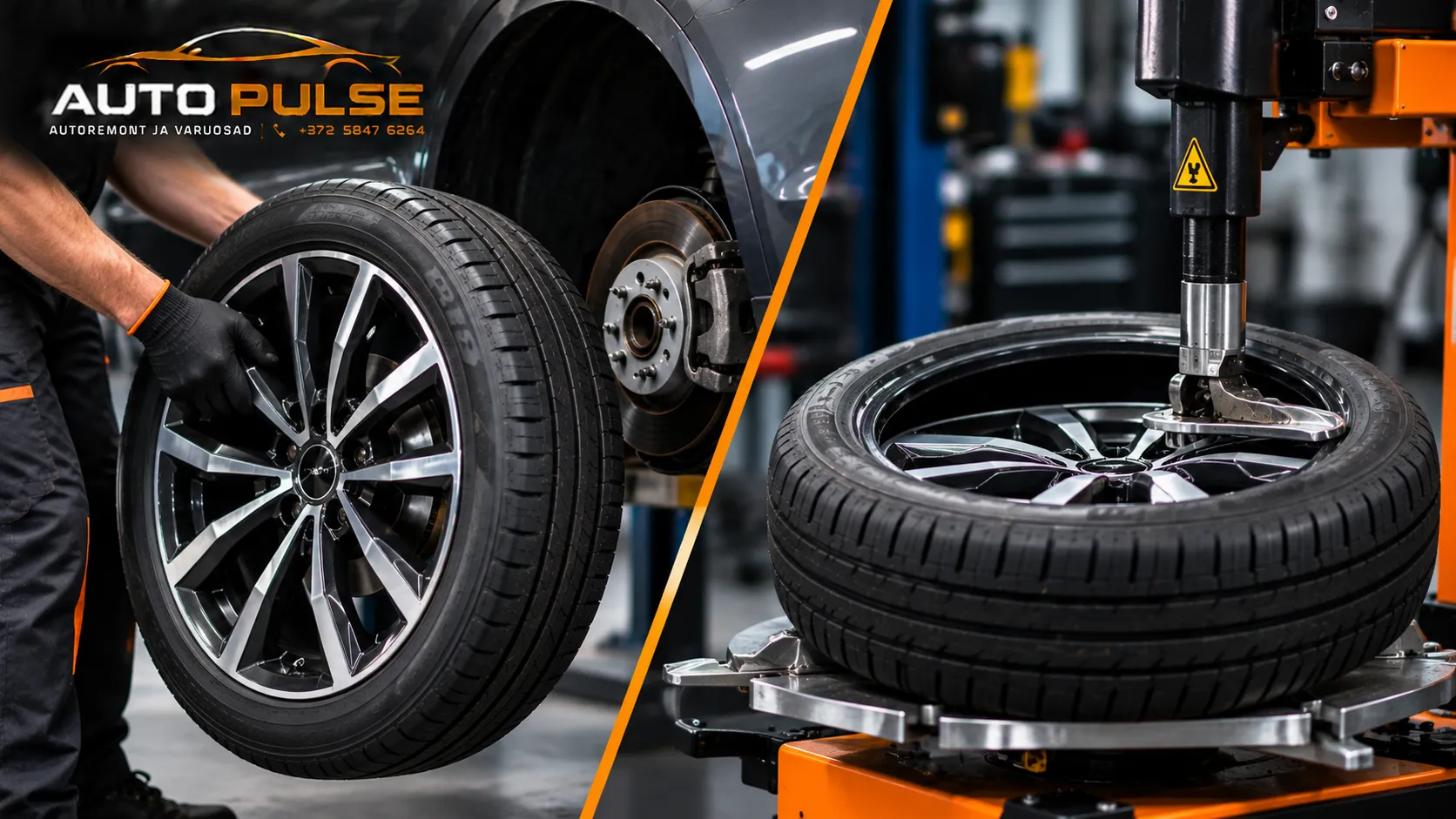
With the arrival of the tire change season, auto service centers in Estonia regularly face the same situation: a driver books a “tire change” but arrives with four complete wheels mounted on rims. Or vice versa — they bring only tires, expecting them to be mounted on the existing rims.
At first glance, the difference seems minor, but for an auto service center, these are two distinct procedures. They differ in technology, duration, and cost.
If you are planning a seasonal tire change in Tallinn, it is important to understand in advance which service your specific vehicle requires.
In this article, the specialists at Auto Pulse explain the difference between wheel replacement and tire replacement, when it is more cost-effective to have two sets of rims, and what you need to consider before booking a tire fitting service.
What is a complete wheel replacement and when is it cost-effective
Complete wheel replacement involves removing one set of assembled wheels from the vehicle and installing another.
Each wheel already consists of a tire and a rim. Therefore, there is no need to separate the tire from the rim.
For example, you have:
- four summer tires on their own rims;
- four winter tires on another set of rims.
In autumn, the technician removes the summer wheels and installs the winter ones. In spring, the reverse procedure is performed.
During the service, the specialist checks the condition of the wheels, tire pressure, and fasteners, and then installs the wheels observing the manufacturer’s recommended torque specifications.
The main advantage of this method is the lack of need to remove tires from rims every season.
If you already have two complete sets, you can choose the “Seasonal Wheel Change” service.
Advantages of having two sets of rims
1. Time savings
Replacing assembled wheels usually takes less time than a full tire fitting.
There is no need to dismount the old tire, mount a new one, and perform balancing after installation.
2. Fewer mounting operations
During a seasonal complete wheel change, the tire bead is not subjected to repeated dismounting and mounting.
This is especially relevant for low-profile and stiff tires that require careful handling.
3. Less contact between tire fitting equipment and rims
When replacing a complete set, a tire changing machine is not used to separate the tire from the rim.
This eliminates the risk of damage associated specifically with this operation.
4. Convenience of seasonal maintenance
If both sets are in good condition, stored properly, and suitable for the vehicle, the seasonal change becomes much easier.
However, even assembled wheels must be inspected before installation. It is also important to check the pressure and the condition of the fasteners.
What is tire remounting (tire replacement) and why is it needed
Tire remounting is a procedure where the technician removes the old tire from the rim and installs a new one.
It is necessary if the vehicle owner has only one set of rims.
For example, winter tires are mounted on the rims in winter, and in spring they need to be removed and replaced with summer tires.
Unlike complete wheel replacement, tire remounting requires the use of specialized tire fitting equipment.
The process usually includes:
- Removing the wheels from the vehicle.
- Dismounting the old tires from the rims.
- Inspecting the rims and mounting surfaces.
- Checking the condition of the valves.
- Applying mounting paste.
- Mounting the other set of tires.
- Inflating the tires to the required pressure.
- Balancing the assembled wheels.
- Installing the wheels back onto the vehicle.
- Final tightening of the fasteners with the required torque.
This is exactly why tire remounting takes more time and usually costs more than a single seasonal change of assembled wheels.
At the same time, using a single set of rims is a standard practice. When performed correctly, tire remounting allows for the safe operation of both summer and winter tires.
What is important in professional tire remounting
Quality tire fitting involves more than just mounting a new tire onto a rim.
The technician must check the condition of the mounting surfaces and ensure that the rim has no damage that would prevent safe operation.
During mounting, a special paste is used, which facilitates the seating of the tire bead and reduces the risk of damaging it.
The condition of the valve is also checked. If necessary, it is replaced or serviced according to its design.
After mounting, balancing is performed.
This allows for the detection and compensation of any imbalance in the assembled wheel, which could cause vibrations while driving.
You can learn more about the available services in the “Auto Pulse Tire Service” section.
Comparison: time, price, and complexity of the process in Tallinn
The main difference between complete wheel replacement and tire remounting lies in the scope of work.
| Parameter | Complete wheel replacement | Tire remounting |
| What happens | Assembled wheels are removed and installed | Tires are removed from rims and replaced |
| Estimated time | 15–30 minutes | 40–60 minutes or more |
| Cost per procedure | Usually lower | Usually higher |
| Second set of rims | Required | Not required |
| Balancing | As needed | After tire mounting |
| Tire changing machine operation | Not required | Required |
| Contact with tire bead | None | Occurs during mounting and dismounting |
| Main advantage | Speed and convenience | No need to buy a second set of rims |
The time indicated is approximate for a set of four wheels. The actual duration depends on the vehicle, tire size, condition of the fasteners, and any additional work.
Which method is cheaper in the long run?
If comparing only a single seasonal procedure, complete wheel replacement is usually cheaper.
However, this requires purchasing a second set of rims.
Tire remounting does not require such an initial purchase, but a larger volume of work is performed every spring and autumn.
Therefore, the economic benefit depends on several factors:
- the cost of the second set of rims;
- wheel size;
- the price difference between the services;
- the duration of vehicle ownership;
- the need to store additional wheels;
- potential costs for TPMS sensors and fasteners.
If you plan to use the vehicle for a long time, a second set of rims may turn out to be a convenient and economically justified solution.
If the vehicle is used temporarily or purchasing additional rims is not feasible, tire remounting remains a practical option.
To calculate your budget, we recommend reading the article “How Much Does Tire Service Cost in Tallinn”.
How to choose the right option for your vehicle
When choosing between wheel replacement and tire remounting, it is important to consider not only the price.
When it is better to choose complete wheel replacement
This option is suitable if:
- you already have two sets of rims;
- you regularly change summer and winter tires;
- you want to reduce the duration of seasonal maintenance;
- you have space for storing wheels;
- both sets are suitable for your vehicle.
An additional advantage is the ability to prepare the second set for the season in advance.
For example, to check the pressure, tread condition, and any damage.
When it is better to choose tire remounting
Tire remounting is suitable if:
- you have only one set of rims;
- you do not want to buy additional rims;
- the vehicle is used for a short period;
- storing two sets of wheels is inconvenient;
- you have purchased new tires for your existing rims.
The main condition is the correct selection of tires and adherence to mounting technology.
Tire size, load index, and speed rating must meet the vehicle’s requirements.
Checklist: which method to choose
Before booking, answer three questions.
1. Do you have a second set of rims?
If yes, complete wheel replacement is usually sufficient.
If not, tire remounting will be required for the seasonal change.
2. How important is it to reduce maintenance time?
Replacing assembled wheels is usually faster, as it eliminates the need to mount tires onto rims.
3. What is the condition of the rims and tires?
If there are cracks, deformations, sidewall damage, or significant wear, an assessment of their suitability for operation is first required.
If you have any doubts, inform the specialist before the work begins.
Common driver mistakes during seasonal tire changes
Even with a simple seasonal change, you can encounter problems if you do not consider certain technical features.
Mistake #1. Not checking the balancing of assembled wheels
If the tire has not been removed from the rim, rebalancing is not always mandatory.
However, during operation or storage, balancing weights could have been lost, rim deformation could have occurred, or other changes might have taken place.
Therefore, if vibrations occur, after wheel repair, or upon discovering damage, it is recommended to check the balancing.
Mistake #2. Ignoring the condition of valves
Over time, the rubber elements of the valve can lose their elasticity.
This can lead to slow air leakage.
During tire remounting, the technician must assess the condition of the valve and recommend replacement if necessary.
For wheels with TPMS sensors, the maintenance procedure may differ from that of standard rubber valves.
Mistake #3. Not controlling the wheel tightening torque
Proper wheel installation requires adherence to the tightening torque specified by the vehicle manufacturer.
Excessive force can damage the threads and fastening elements.
Insufficient tightening creates a risk of the wheel fastening loosening.
Therefore, the final tightening must be performed with an appropriate torque tool.
Mistake #4. Not checking the condition of tires before installation
Even if the tires were stored correctly, it is recommended to check the following before the new season: