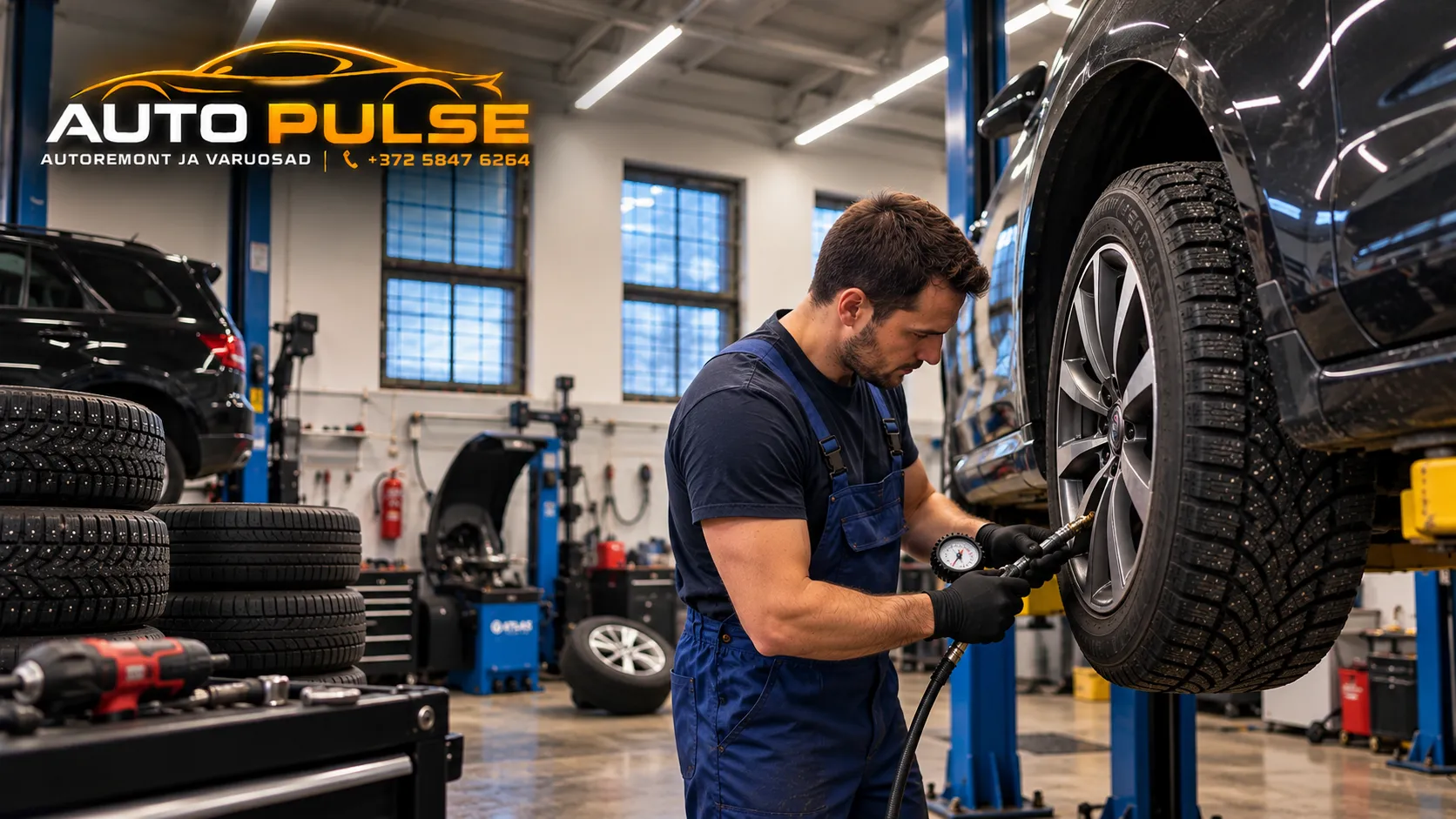
With the arrival of warm days, many car owners in Tallinn and throughout Estonia are wondering: is it allowed to drive on winter tires in summer in Estonia to save on tire fitting or postpone the seasonal tire change?
The short answer: driving on non-studded winter tires in summer is allowed, while the use of studded tires is restricted by law. However, even if non-studded winter tires meet technical requirements, their operation in hot weather is not always safe or economically justified.
Winter tires are designed for cold weather, snow, and ice. On warm asphalt, they can wear out faster, increase braking distance, and worsen vehicle handling.
In this article, the AutoPulse specialists will explain the current regulations in Estonia for 2026, the periods for using studded tires, possible fines, and the technical consequences of driving on winter tires in summer.
Is it allowed to drive on winter tires in summer according to Estonian law?
Estonia has specific requirements for the seasonal use of vehicle tires.
At the same time, it is important to distinguish between two types of winter tires:
- Studded winter tires — have metal studs and are subject to seasonal restrictions.
- Non-studded winter tires (friction tires) — do not have metal studs and can be used year-round, provided they meet technical requirements.
Periods for using studded tires
In Estonia, the use of studded tires is permitted:
- From October 15 to March 31 — under normal conditions.
- From October 1 to April 30 — if winter road and weather conditions require it.
Thus, after March 31, the use of studded tires is allowed only under appropriate winter conditions and no later than April 30.
From May 1, the operation of studded tires on public roads is prohibited.
Therefore, owners of vehicles with studded tires need to plan their seasonal tire change in advance.
Are summer tires mandatory from May 1?
No. In Estonia, there is no general requirement that all vehicles must necessarily use summer tires from May 1.
The law restricts the use of studded tires but does not prohibit the year-round operation of suitable non-studded winter tires.
At the same time, the driver is obliged to monitor the technical condition of the wheels, the tread depth, and the compliance of the tires with safety requirements.
Can you drive on non-studded winter tires in summer?
Yes, non-studded winter tires are allowed to be used in summer in Estonia.
However, legal permission does not mean that this decision is optimal from a safety perspective.
Friction winter tires are designed primarily for low temperatures.
In warm weather, their performance may be inferior to quality summer tires, especially during emergency braking and cornering.
Therefore, for regular summer operation, it is recommended to use tires intended for the appropriate season.
Detailed information on seasonal requirements can be found on the official website of the Estonian Transport Administration — Transpordiamet.
Fines and risks of using winter tires in summer
Violation of vehicle tire requirements may entail administrative liability.
However, it is important to distinguish between the lawful use of non-studded winter tires and the operation of studded tires outside the permitted period.
What violations can result in a fine?
Violations of technical requirements may include:
- Using studded tires after the end of the permitted period.
- Insufficient tread depth.
- Operating tires with dangerous damage.
- Using tires that do not meet mandatory technical requirements.
The amount of the fine depends on the circumstances and the applicable article of Estonian legislation.
Therefore, it is incorrect to specify a universal fine of 200–400 euros for any seasonal mistake.
Current penalty amounts should be checked in the current version of the legislation on the Riigi Teataja website.
Can an insurance company refuse to pay out?
Using winter tires in summer does not mean an automatic refusal of insurance compensation.
When considering a traffic accident, the following factors matter:
- The technical condition of the vehicle.
- Compliance of the tires with legal requirements.
- The circumstances of the accident.
- The presence of a causal link between the condition of the tires and the accident.
- The terms of the insurance contract.
- The applicable legislation.
If unsuitable or faulty tires contributed to the accident, this may affect the consideration of the insurance claim.
However, the consequences differ for mandatory third-party liability insurance and voluntary comprehensive insurance (CASCO).
The mere fact of the lawful use of non-studded winter tires in summer is not an automatic ground for canceling the insurance policy or refusing a payout.
How winter tires behave on hot asphalt
Even if the use of non-studded winter tires in summer is permitted, there are technical reasons why it is recommended to switch to a summer set in a timely manner.
1. Accelerated tread wear
Winter tires have a special rubber compound designed to work at low temperatures.
In hot weather, winter tires can wear out faster, especially during intensive acceleration, braking, and high-speed driving.
The degree of wear depends on the specific model, temperature, pressure, and driving style.
As a result, by the next winter season, the tread depth may be insufficient.
This means additional expenses for purchasing a new set.
2. Increased braking distance
On warm, dry, and wet asphalt, quality summer tires usually provide more suitable braking performance.
Winter models have a different rubber compound and tread pattern designed for cold conditions.
During emergency braking, the difference in grip can significantly affect the distance required to stop the vehicle.
The exact braking distance depends on the tire model, speed, road surface, and temperature.
Therefore, it cannot be stated that any winter tires always brake a certain number of meters worse than summer ones.
However, for regular summer driving, it is preferable to use a seasonal set.
3. Risk of hydroplaning
Hydroplaning occurs when a layer of water forms between the tire and the road surface.
At the same time, the wheel partially or completely loses contact with the road, which worsens braking and handling.
The risk of hydroplaning depends on several factors:
- Vehicle speed.
- Water depth on the road.
- Residual tread depth.
- Tire construction.
- Tire pressure.
- Road surface condition.
Some winter tires are capable of effectively dispersing water, so it cannot be stated that all winter models are necessarily worse than summer ones in resisting hydroplaning.
However, worn winter tires used in summer can create additional risks.
4. Reduced handling precision
Winter tires have a construction and tread pattern designed for specific road conditions.
At high temperatures and during active maneuvering, a vehicle on winter tires may respond to steering inputs less precisely than on a suitable summer set.
The differences can be especially noticeable:
- During sharp lane changes.
- While cornering.
- During emergency braking.
- When driving at high speeds.
- When the vehicle is fully loaded.
Therefore, for summer trips on urban roads and highways in Estonia, it is recommended to use quality summer tires.
When more than just tire fitting is required
Seasonal tire change is a convenient time for an additional check of the vehicle’s technical condition.
When the wheels are removed, a specialist can visually assess the condition of some elements of the braking system and suspension.
Checking brake pads and discs
Before the summer season, it is recommended to pay attention to:
- The residual thickness of the brake pads.
- The condition of the brake discs.
- The presence of corrosion.
- Signs of uneven wear.
- Visible damage to the braking mechanisms.
If suspicious signs are detected, a more detailed diagnosis may be required.
Suspension check
During wheel maintenance, you can pay attention to the condition of:
- Shock absorbers.
- CV joint boots.
- Ball joints.
- Silent blocks (bushings).
- Tie rod ends.
- Other elements accessible for inspection.
At the same time, a full suspension diagnosis requires separate checks and is not limited to a visual inspection during tire fitting.
Pressure and balancing check
After installing summer wheels, it is necessary to check the tire pressure.
It must comply with the vehicle manufacturer’s recommendations.
Proper pressure affects handling, fuel consumption, and tread wear uniformity.
If tires are dismounted from the rims and reinstalled, wheel balancing is usually performed.
During the seasonal swap of assembled wheels, the need for additional balancing is determined by their condition and the presence of vibrations.
You can learn more about vehicle maintenance on the official AutoPulse website.
How to prepare wheels for a service visit
To make the seasonal tire change faster, it is recommended to prepare the summer set in advance.
1. Check the condition of summer tires
Inspect the tread and sidewalls.
Ensure there are no:
- Deep cuts.
- Bulges.
- Cracks.
- Visible cord damage.
- Severe uneven wear.
If suspicious defects are found, show the tires to a specialist.
2. Measure the tread depth
The minimum allowable tread depth for summer tires in Estonia is 1.6 mm.
However, for confident driving on wet roads, it is recommended to consider replacement when the residual depth is around 3 mm.
If you are unsure about the condition of the set, the depth can be checked with a special gauge.
3. Clean the wheels from heavy dirt
Before visiting the service center, it is advisable to remove large dirt deposits from the tires and rims.
Dirt and foreign deposits can hinder inspection and affect balancing accuracy.
Final cleaning of the necessary surfaces is performed when preparing the wheel for service.
4. Check the completeness of the wheels
If summer tires are stored separately from the rims, ensure that the set matches the vehicle in size and other necessary characteristics.
If special wheel bolts, nuts, or locking wheel nuts are used, prepare the appropriate key.
5. Clarify the cost of tire fitting
Before visiting the auto service center, it is useful to find out the cost of the work in advance.
The price may depend on:
- Rim diameter.
- Vehicle type.
- Tire size.
- The need to dismount tires from the rims.
- Balancing.
- Additional work and consumables.
To plan your budget, we recommend reading the article “How much does tire service cost in Tallinn?”.
You can also check out AutoPulse tire fitting services.
Frequently Asked Questions (FAQ)
What is the fine for winter tires in summer in Estonia?
If we are talking about non-studded winter tires, their use in summer is not prohibited in itself.
Administrative liability may arise for using studded tires outside the permitted period or operating technically faulty tires.
The exact amount of the fine depends on the nature of the violation and the current legislation.
Does insurance cancel the payout for an accident on winter tires in summer?
No, this does not happen automatically.
The insurance company considers the circumstances of the incident, the technical condition of the vehicle, the terms of the contract, and the applicable legal norms.
If the condition of the tires influenced the occurrence of the accident, this may be significant when considering the insurance claim.
Can you drive on non-studded winter tires (friction tires) in summer?
Yes. In Estonia, the use of non-studded winter tires in summer is allowed.
However, for driving on warm asphalt, quality summer tires are usually more suitable.
Winter tires can wear out faster and demonstrate less suitable braking and handling characteristics.
Until what date can you drive on studded tires?
Under normal conditions — until March 31.
If winter road and weather conditions persist, use is permitted until April 30.
From May 1, the use of studded tires is prohibited.
When is the best time to change winter tires to summer ones in Tallinn?
A practical guideline is a stable temperature above +5…+7 °C with no snow or ice on your usual routes.
In Tallinn, suitable conditions often arrive in April, but the exact date depends on the weather.
Can you use winter tires in summer to wear out an old set?
The law allows the use of suitable non-studded winter tires in summer.
However, it is necessary to consider their technical condition, residual tread depth, and handling characteristics on warm roads.
If the tires are heavily worn or damaged, continuing to use them is dangerous.
Book your seasonal tire change at AutoPulse
It is not worth risking safety and the condition of your vehicle for the sake of temporary savings on seasonal tire changes.
A properly selected set helps ensure suitable handling, braking, and comfort characteristics in the corresponding weather conditions.
If you are unsure whether it is time to change winter tires to summer ones, or if you want to prepare your vehicle for the season in advance, contact AutoPulse.
We will help with seasonal tire fitting in Tallinn.
AutoPulse — auto repair and spare parts in Tallinn.
Phone: +372 5847 6264
Website: https://autopulse.ee/