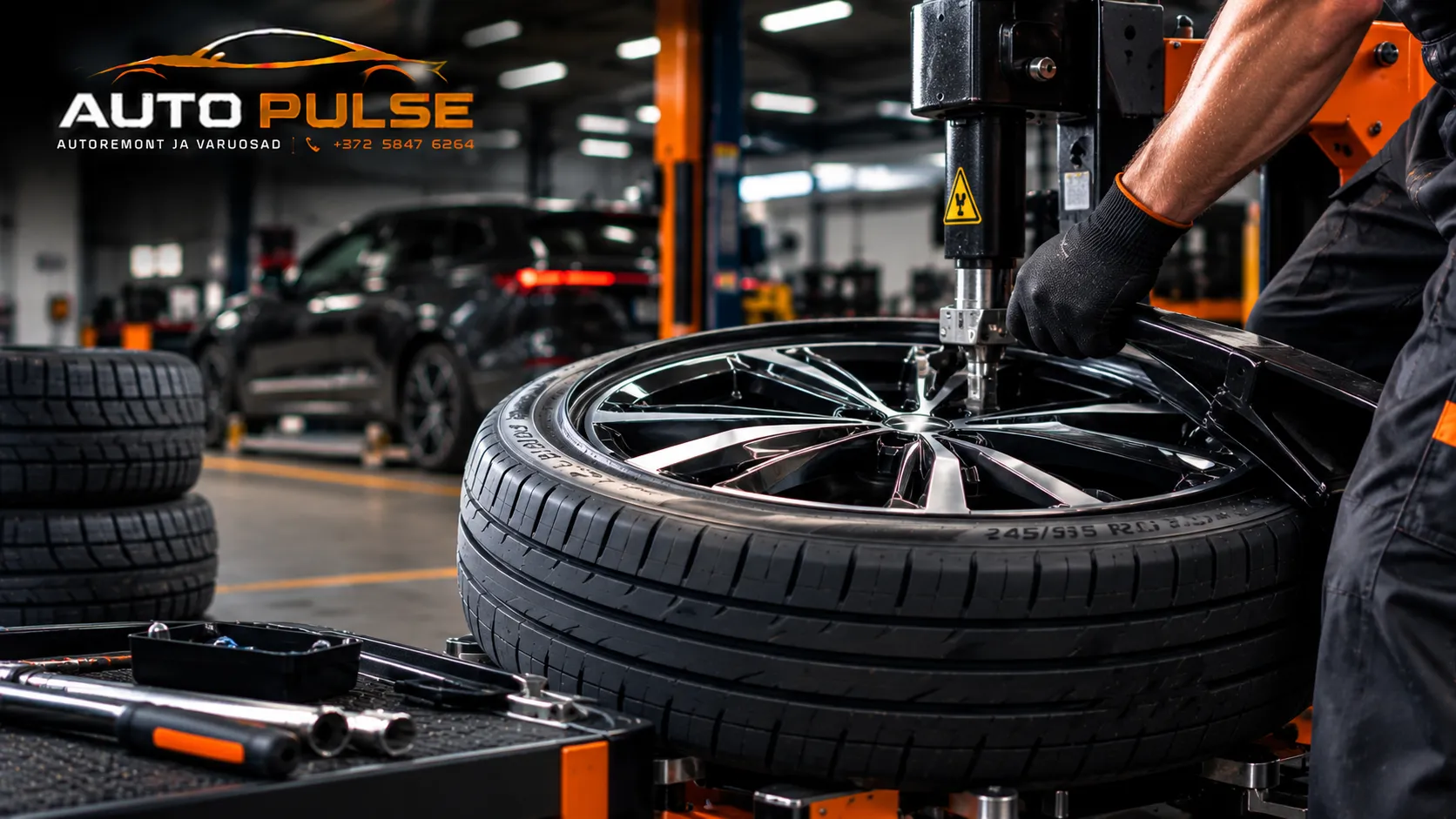
Low-profile tires have long ceased to be an attribute of exclusively sports cars. Today they can be found on city sedans, premium crossovers, and electric vehicles.
Such tires often provide a more precise response of the car to steering inputs and give it a sporty appearance. However, the small sidewall height creates additional requirements for operation and maintenance.
Low-profile tire fitting in Tallinn is a procedure where proper equipment, the technician’s carefulness, and adherence to mounting technology are especially important.
Mistakes when working with stiff tires can lead to damage to alloy wheels, the tire bead, or its internal components.
Let’s explore why low-profile tires require special attention, what equipment is used for their maintenance, and what the cost of changing tires depends on.
What is a low-profile tire and what are its vulnerabilities
The tire profile is the ratio of the sidewall height to the width, expressed as a percentage.
For example, the marking 225/40 R18 means:
- 225 — tire width in millimeters.
- 40 — sidewall height is 40% of the tire width.
- R — radial construction.
- 18 — rim mounting diameter in inches.
In this case, the calculated sidewall height is 90 mm.
Tires with profile ratings of 40, 35, 30, and below are usually classified as low-profile, although there is no single universal definition.
Stiff sidewall and low deformation margin
When mounting a tire on a rim, its bead must pass over the rim flange and take the correct position.
In low-profile models, the sidewall is usually less flexible than in high-profile tires.
Therefore, the mounting process may require additional effort and the use of auxiliary tools.
Improper handling carries the following risks:
- damage to the wheel’s paintwork;
- deformation of the tire bead;
- sidewall damage;
- emergence of hidden structural defects.
It is especially important to follow the technology when servicing wide, large-diameter tires.
RunFlat design features and their impact on mounting
Some cars are equipped with RunFlat technology tires.
Depending on the design, such tires allow you to continue driving after a loss of pressure for a limited distance and at a limited speed.
For a number of models, manufacturers indicate the possibility of driving up to 80 km at a speed not exceeding 80 km/h, however, specific limitations must be checked in the documentation.
Many RunFlat tires have reinforced sidewalls.
This complicates their mounting and dismounting, so special tools may be required for the job.
Important: a low-profile tire is not necessarily a RunFlat. These are different technical specifications.
Main risks of unprofessional tire fitting
Improperly performed tire fitting can lead to damage, the cost of fixing which significantly exceeds the price of the service itself.
Therefore, when choosing an auto service center, it is necessary to consider not only the cost but also the approach to performing the work.
Why standard machines can scratch or deform a wheel
During tire fitting, the equipment interacts with both the tire and the wheel.
If the mounting head is improperly adjusted or unsuitable tools are used, there is a risk of metal elements coming into contact with the wheel surface.
Particularly sensitive to damage are:
- painted alloy wheels;
- polished surfaces;
- wheels with decorative coatings;
- large-diameter wheels.
To reduce the risk, protective pads and auxiliary mounting devices are used.
At the same time, even modern equipment does not completely eliminate the human factor.
The safety of tire fitting depends simultaneously on the technical equipment and the technician’s qualifications.
Risk of cord and sidewall damage during dismounting
A tire has a complex internal structure.
It consists of rubber layers, reinforcing elements, bead rings, and other components.
Excessive mechanical stress can damage the bead or internal elements of the tire.
Some defects are noticeable immediately, such as cuts or tears.
Others may appear later in the form of a sidewall bulge.
Such a bulge may indicate damage to the internal structure of the tire.
If such a defect is found, further use of the tire may be dangerous.
It is necessary to consult a specialist to assess its condition.
What equipment is necessary for safe mounting
For servicing low-profile tires, it is important to use tire fitting equipment that matches the size and design of the wheels.
Modern machines can be equipped with various systems that facilitate working with stiff tires.
Contactless and automated mounting systems
Some professional tire changers use technologies that reduce the contact of metal tools with the wheel.
Special mounting heads, rollers, and automated mechanisms are used for this purpose.
Such solutions help reduce the likelihood of damage to the wheel surface.
However, the quality of work still depends on the correct adjustment of the equipment and adherence to the technology.
Plastic protective attachments
Protective elements are installed on the working parts of the equipment that may come into contact with the wheel.
They help reduce the likelihood of scratches and other cosmetic damage.
Such devices are especially useful when working with alloy wheels.
Bead mounting assistance system — Bead Assist
Special pressing devices can be used for stiff tires.
They help hold the tire bead in the mounting drop center of the wheel.
This facilitates the installation of low-profile tires and reduces the need to apply excessive force.
Intensive air supply system
Some tire changers are equipped with short-term compressed air supply devices.
They help ensure the initial sealing of the tire on the wheel in situations where a standard air supply is insufficient.
However, the use of such systems requires adherence to safety measures and the manufacturer’s recommendations.
Not every low-profile tire requires such a procedure.
Features of balancing low-profile wheels
Balancing is a mandatory step after mounting a tire on a wheel.
It allows compensating for the uneven distribution of the wheel’s mass and reduces the likelihood of vibrations while driving.
For low-profile wheels, the accuracy of centering on the balancing machine is especially important.
Why centering accuracy matters
If the wheel is improperly secured on the balancing equipment, the measurement results may be inaccurate.
As a result, after mounting the wheel on the car, the driver may notice vibrations despite the balancing performed.
At the same time, vibration is not always exclusively related to imbalance.
Its causes can also include:
- wheel deformation;
- tire damage;
- improper wheel centering;
- suspension malfunctions;
- contamination of contact surfaces.
Cone and flange adapters
Various centering methods are used to mount wheels on a balancing machine.
Cone adapters provide fixation relative to the center hole of the wheel.
Flange adapters allow using a mounting method close to mounting the wheel on the car’s hub.
The choice of method depends on the wheel design and the equipment.
Flange adapters can be useful when facing centering difficulties, but they are not mandatory for all low-profile wheels.
Proper tightening of wheel fasteners
After tire fitting, the wheels must be properly mounted on the vehicle.
The final tightening of bolts or nuts must be performed with the torque recommended by the vehicle manufacturer.
A torque wrench is used for this purpose.
Insufficient tightening can lead to loosening of the fasteners, while excessive tightening can damage the threads and other components.
How much does low-profile tire fitting cost in Tallinn
The cost of servicing low-profile tires depends on several factors.
The main ones are:
- wheel diameter;
- tire width;
- profile height;
- presence of RunFlat technology;
- wheel design;
- need for additional operations;
- condition of the wheels and fasteners.
For example, mounting 225/40 R18 and 255/30 R20 tires may differ in complexity and duration.
However, it cannot be stated that any low-profile tire automatically requires twice as much time or costs twice as much.
The final cost is determined by the current price list and the list of necessary works.
What is included in a full tire change
Usually, a full tire change for four wheels includes:
- Removing the wheels from the vehicle.
- Dismounting the old tires.
- Inspecting the wheels and valves.
- Mounting the new tires.
- Inflating to the recommended pressure.
- Balancing the wheels.
- Mounting the wheels on the vehicle.
- Final tightening of the fasteners.
Additional operations may be charged separately.
More details on cost formation can be found in the article “How much does tire fitting cost in Tallinn”.
Current service offerings are presented in the “Auto Pulse Tire Fitting” section.
How to prepare your car for a service visit
To ensure tire fitting proceeds without unnecessary delays, it is recommended to prepare some information in advance.
1. Clarify the wheel parameters
Check the marking on the tire sidewall.
For example: 225/40 R18.
This information will help determine the specifics of the service in advance.
2. Inform about the tire type
If you have RunFlat or other tires with a special design, warn about this when booking.
It is also useful to mention if the wheel has been repaired previously.
3. Inspect the tires and wheels
Before your visit, pay attention to:
- bulges;
- cuts;
- cracks;
- wheel deformations;
- uneven tread wear.
If any damage is found, inform the technician.
4. Prepare the locking wheel nut key
If the vehicle is equipped with locking wheel bolts or nuts, ensure that the corresponding adapter is in the