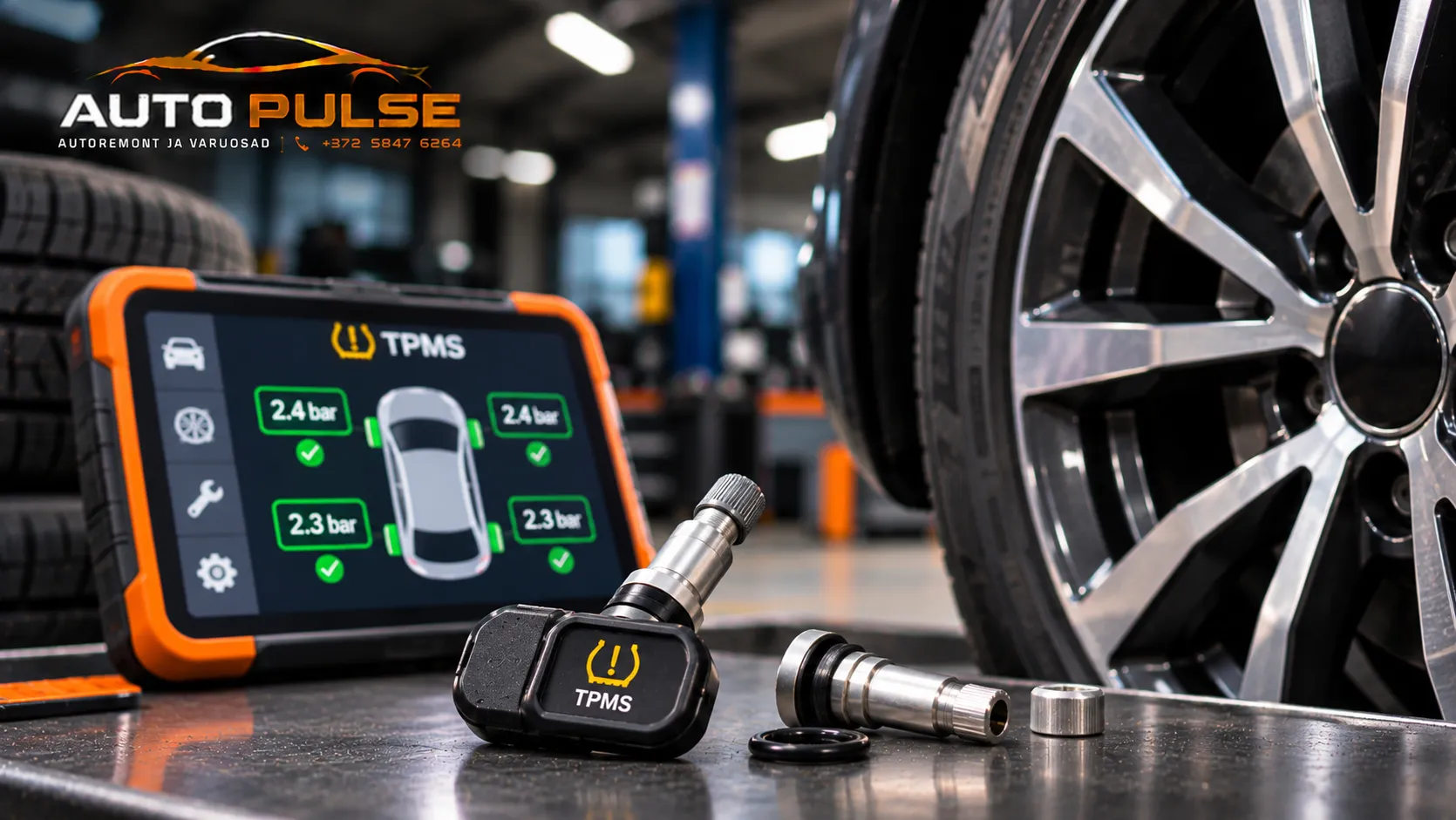
The Tire Pressure Monitoring System — TPMS (Tire Pressure Monitoring System) — has become a standard feature in modern vehicles. It helps the driver notice a drop in pressure in time and prevent situations where an underinflated tire worsens handling or gets damaged while driving.
However, during seasonal tire changes, the presence of pressure sensors requires extra attention. If a sensor is installed inside the wheel, improper removal can lead to damage to its housing, valve, or mounting.
Tire fitting for wheels with pressure sensors in Tallinn must be performed taking into account the design of the specific TPMS system and the vehicle manufacturer’s recommendations.
In this guide, Auto Pulse explains how TPMS works, what rules help avoid sensor damage, when valve replacement is required, and what determines the cost of maintenance.
What is a TPMS system and why it requires special attention
TPMS is designed to monitor tire pressure and warn the driver of any drop.
There are two main types of systems: direct and indirect.
Indirect TPMS
Indirect TPMS uses information from the ABS sensors and other electronic systems of the vehicle.
It analyzes changes in wheel rotation characteristics and detects possible pressure drops.
In such a system, there are no separate electronic sensors inside the wheels.
Therefore, during tire mounting/dismounting, it is impossible to damage an internal TPMS sensor, as there is none.
However, after a pressure change or seasonal wheel replacement, some vehicles require system reinitialization via the menu.
Direct TPMS
A direct system uses electronic sensors located inside the wheels.
They are usually mounted near the valve and measure air pressure.
Depending on the design, the sensor may also measure temperature.
A typical sensor includes:
- an electronic module;
- a housing;
- a power battery;
- a sensing element;
- a valve and mounting components.
The obtained data is transmitted to the vehicle’s electronic system.
The main feature of direct TPMS: the electronic module is located inside the wheel and can be damaged if mounting tools are used incorrectly.
This is exactly why its location must be taken into account during tire fitting.
5 main rules for safe maintenance of wheels with TPMS
1. Always inform the technician about the presence of sensors
Before tire fitting, inform the technician if you know that electronic pressure sensors are installed in the wheels.
This is especially important if:
- the vehicle is equipped with an additional set of rims;
- universal TPMS sensors were previously installed;
- a pressure error appears on the dashboard;
- non-original wheels are used;
- the sensors were recently replaced.
If you are unsure which system is installed, provide the make, model, and year of manufacture of the vehicle.
This information can be used to clarify the design features.
Do not rely solely on the appearance of the valve: different TPMS systems may use various types of mounting.
2. Properly maintain valves: rubber and metal
The valve is responsible for the wheel’s airtightness.
During operation, it is exposed to moisture, temperature fluctuations, and road chemicals.
Over time, individual components may wear out.
Rubber valves
Rubber elements gradually lose their elasticity.
During tire mounting/dismounting, their condition must be assessed and replaced if necessary.
The replacement frequency depends on the valve design and the manufacturer’s recommendations.
Metal TPMS valves
Metal constructions may use replaceable sealing rings, nuts, valve cores, and other components.
Special service kits are provided for maintenance.
Compatible parts must be used.
Unsuitable seals or fasteners can lead to a loss of airtightness.
Why you cannot install just any universal valve
Not every valve is suitable for a specific TPMS sensor.
Incorrectly selected parts can cause:
- air leaks;
- mounting damage;
- corrosion;
- loss of airtightness;
- the need for repeated repairs.
After maintenance, the airtightness of the connection must be checked.
At the same time, the electronic sensor itself does not need to be replaced during every seasonal tire change if it is functioning properly.
3. Careful tire dismounting and mounting
One of the most critical stages is removing the tire from the rim.
The mounting tool interacts with the tire bead, which, if moved incorrectly, can impact the sensor.
Therefore, the technician must determine the valve’s location and take it into account during every operation.
The safe sequence depends on the design of the tire changing machine, the wheel, and the direction of the bead movement.
A single universal rule cannot be applied, stating that the valve must always be strictly in the “12 o’clock” position.
At different stages of mounting, the safe position may vary.
Special mounting tools and protective covers may be used to protect the rims and wheel components.
The main rule: the tool and the tire bead must not create dangerous stress on the sensor housing.
4. Balancing taking into account the wheel design
After mounting the tire on the rim, balancing must be performed.
It compensates for the uneven mass distribution of the wheel and helps reduce vibrations during driving.
The TPMS sensor has its own weight, but its position does not automatically determine where the balancing weight should be placed.
The balancing machine measures the imbalance of the entire wheel assembly.
Based on the measurement results, the technician determines the necessary weight and placement of the weights.
Therefore, placing the counterweight strictly opposite the valve is not a universal rule.
If vibrations occur after tire fitting, the balancing, rim condition, and tire condition must be checked.
5. System check and adjustment after installation
After tire fitting, it is important to check the pressure in all wheels and ensure that the TPMS system is working correctly.
On some vehicles, sensor initialization or relearning is required after wheel replacement.
Possible procedures include:
- resetting via the vehicle menu;
- automatic sensor recognition while driving;
- wheel position learning;
- registration of new sensors using diagnostic equipment.
However, programming is not always necessary.
If the previous functioning sensors are used and the vehicle recognizes them automatically, no additional operations may be required.
If an error occurs, the pressure should first be checked to determine the cause of the warning.
Common mistakes during tire fitting with TPMS
Sensor housing damage
If the mounting tool or tire bead impacts the sensor, its housing or mounting may be damaged.
In some cases, the electronic module will need to be replaced.
Therefore, it is important to follow the dismounting procedure.
Using unsuitable seals
Not all service kits are compatible with each other.
Installing unsuitable parts can lead to slow air leaks.
During repair, the design of the sensor and valve must be taken into account.
Lack of airtightness check
Even after the correct installation of a new valve, the connection must be checked.
A minor leak may appear some time after maintenance.
Incorrect TPMS setup
After installing another set of wheels, the vehicle sometimes fails to recognize the new sensors.
However, a TPMS error does not always mean that programming is necessary.
The cause could be:
- a drop in pressure;
- a faulty sensor;
- a depleted battery;
- communication failure;
- the need for reinitialization.
Therefore, the correct approach is to identify the cause of the error, rather than just clearing the warning.
How much does wheel maintenance with TPMS cost in Tallinn
The cost depends on the type of wheels and the required scope of work.
The presence of pressure sensors alone does not mean that a standard seasonal change will necessarily be more expensive.
Additional costs may arise if the following is required:
- valve replacement;
- installation of a service kit;
- checking a faulty sensor;
- replacement of the electronic module;
- programming a new sensor;
- fixing an air leak.
TPMS maintenance cost at Auto Pulse
The source materials indicate a benchmark of from 15 € per wheel for maintaining a valve with a TPMS sensor, including seal replacement and airtightness check.
The validity of this price must be confirmed before publication.
The final cost depends on the valve design, required materials, and additional operations.
For more details on seasonal expenses, read the article “How much does tire service cost in Tallinn”.
What to do if a TPMS error lights up after tire fitting
If a pressure monitoring indicator appears on the dashboard, you should not immediately assume the sensor is faulty.
First of all, you need to check the actual tire pressure.
Recommended course of action:
- Stop in a safe place.
- Inspect the tires for damage.
- Check the pressure with a gauge.
- If a leak is detected, fix its cause.
- If the pressure is normal, check the initialization procedure in the vehicle manual.
- If the warning persists, seek diagnostics.
You should not simply reset the error without checking the pressure.
FAQ: Frequent questions about tire pressure sensors
Can you drive with a broken TPMS sensor?
The vehicle may remain drivable, but the pressure monitoring system will work incorrectly or completely stop performing its function.
This increases the risk of not noticing a dangerous drop in pressure.
It is recommended to fix the malfunction.
The impact of such a malfunction on passing the technical inspection in Estonia must be assessed according to current requirements.
Do you need to replace the sensor with every tire change?
No.
A functioning electronic sensor does not need to be replaced during every tire mounting/dismounting.
At the same time, individual serviceable valve elements may need replacement according to the manufacturer’s recommendations.
How long does a TPMS sensor last?
The service life depends on the manufacturer, design, and operating conditions.
The batteries of many sensors are designed for several years of operation, often around 5–10 years.
However, the actual lifespan may vary.
In most common sensors, the battery is built-in, so when it depletes, the electronic module is replaced.
What to do if a TPMS error is on after tire fitting?
First, check the pressure in all wheels.
If it is normal, a sensor malfunction, the need for initialization, or a problem recognizing another set of wheels is possible.
Diagnostics may be required to accurately determine the cause.
Do you need to program TPMS with every seasonal change?
No.
Some vehicles automatically recognize the installed sensors.
Others require a learning procedure or registration of new identifiers.
It all depends on the system design.
Can you install wheels without pressure sensors?
On a vehicle with direct TPMS, installing wheels without the necessary sensors can lead to a constant warning and loss of the pressure monitoring function.
When selecting a second set of wheels, the vehicle manufacturer’s requirements should be taken into account.
Conclusion
Tire fitting for wheels with TPMS pressure sensors requires careful handling of electronic components and the correct selection of consumables.
To avoid damage and additional expenses, it is important to inform the technician in advance about the presence of sensors, follow the mounting technology, and check the system’s operation after wheel installation.
Need tire fitting for wheels with TPMS in Tallinn?
Contact Auto Pulse to clarify the maintenance cost, the possibility of working with your vehicle model, and a convenient time for your visit.
Auto Pulse — Pae 28, Tallinn
Phone: +372 5847 6264