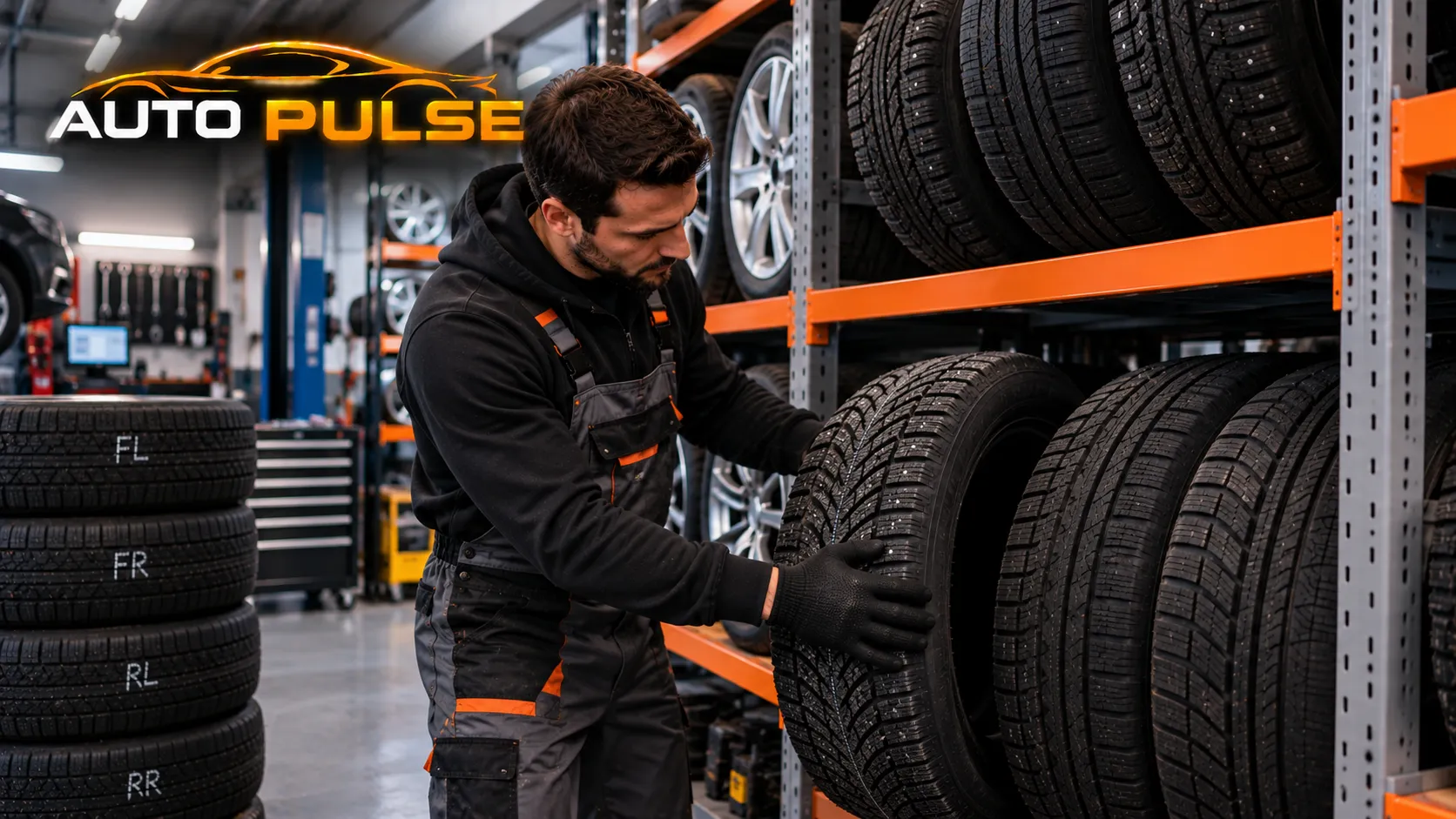
Seasonal tire replacement is not just about installing a suitable set on the car. It is equally important to properly organize the storage of removed wheels until the next season.
Many car owners simply store tires in the garage, basement, or on the balcony. However, improper storage conditions can accelerate rubber aging, contribute to tire deformation, and worsen their performance characteristics.
How to properly store tires with and without rims? What temperature is suitable for storage? Can wheels be left on the balcony? Should the pressure be reduced?
In this guide, the specialists at Auto Pulse explain how to prepare tires for storage, what mistakes drivers make, and how to keep the set in good condition until the next season.
If you are still planning a seasonal change, we recommend reading the article “When to Change Winter Tires to Summer Tires in Estonia”.
Why it is important to follow tire storage rules
A car tire is a complex structure made of rubber compounds, textile, and metal elements.
Its characteristics depend not only on mileage but also on operating and storage conditions.
Improper storage can lead to the following problems.
Accelerated rubber aging
Direct sunlight, high temperatures, and ozone exposure contribute to the aging of rubber compounds.
Over time, the material may lose its elasticity, and cracks may appear on the surface.
It is especially undesirable to leave tires near heating appliances, sources of intense heat, and equipment that emits ozone.
Tire deformation
If tires are stored under improper load for a long time, their shape may change.
For example, storing tires without rims in a high stack or hanging them by the sidewall creates an undesirable load on the structure.
As a result, vibrations or other problems may appear after installation.
Not every temporary deformation is irreversible, but proper placement helps reduce the risk of damage.
Damage to rims and metal elements
If wheels are stored wet and dirty, the remaining moisture and road salt can contribute to the corrosion of metal parts.
Therefore, it is recommended to thoroughly clean and dry the set before storage.
How to prepare tires for storage: a step-by-step checklist
Preparation takes a little time but helps maintain the condition of the tires and identify damage in advance.
1. Wash the tires and rims
After the winter season, road salt, dirt, and other contaminants remain on the wheels.
For cleaning, use water, a soft brush, and a suitable automotive detergent.
Pay special attention to:
- Tread grooves.
- Tire sidewalls.
- The inner surface of the rims.
- Areas where road dirt accumulates.
- Foreign objects stuck in the tread.
After washing, thoroughly rinse the wheels.
2. Completely dry the set
Tires and rims must be dry before packaging.
It is not recommended to put wet wheels in airtight bags: moisture inside the packaging can contribute to rim corrosion.
For drying, choose a well-ventilated area without intense heat or direct sunlight.
3. Inspect the tread and sidewalls
Before storage, it is convenient to assess the condition of the removed set.
Check:
- Remaining tread depth.
- Uniformity of wear.
- Presence of cracks.
- Cuts and punctures.
- Bulges on the sidewalls.
- Rim damage.
If a tire has serious damage, it is better to resolve the issue of repair or replacement before the next season.
Do not store an unsuitable set, expecting to use it in six months.
4. Is treatment with protective compounds necessary?
For proper storage, it is usually enough to clean and dry the tires.
Special rubber care products can be used if they are intended for car tires and approved by the manufacturer.
However, such compounds do not replace proper storage conditions and do not restore aged rubber.
Do not apply gasoline, solvents, oils, or unsuitable chemicals to the tires.
Also, avoid getting care products on the working surface of the tread unless specified in the instructions.
5. Mark the wheel positions
Before removal, it is advisable to note where each wheel was located.
For example:
- FL — front left.
- FR — front right.
- RL — rear left.
- RR — rear right.
Such marking will help assess the wear pattern and, if necessary, rotate the wheels in the next season.
However, tires must be rotated taking into account the car manufacturer’s recommendations, size, and tread direction.
How to properly store tires without rims
Tires without rims are recommended to be stored vertically on a flat surface or a suitable rack.
This method helps avoid prolonged load from other tires on the bottom part of the set.
Proper storage method
Place the tires vertically, next to each other.
It is advisable to use a clean, flat surface or a special rack.
During long-term storage, you can periodically slightly change the position of the tires so that the load does not constantly fall on one area.
What to avoid
It is not recommended to:
- Hang tires without rims on narrow hooks.
- Store them under heavy objects for a long time.
- Stack them in high piles.
- Strongly compress the sidewalls.
- Place them near heat sources.
The main rule: tires without rims are best stored vertically.
How to properly store wheels assembled with rims
If tires are mounted on rims, the storage rules are different.
Assembled wheels can be stored horizontally, stacked in a stable pile, or hung by the rim on suitable mounts.
Horizontal storage
For a set of four wheels, a horizontal stack is a convenient option.
Before placing them, ensure the wheels are clean and dry.
The surface must be flat, and the stack must be stable.
It is advisable to use protective covers or pads to avoid rim damage.
Hanging by the rim
Assembled wheels can also be hung by the center hole of the rim using suitable mounts.
It is important that the mount can withstand the weight of the wheel and does not damage the rim.
Hanging a tire without a rim in a similar way is not recommended.
Should pressure be reduced before storage?
Usually, assembled wheels are stored with pressure corresponding to the car or tire manufacturer’s recommendations.
You should not automatically rely on a universal value of 2.0–2.2 bar: the required pressure depends on the car and wheel size.
Before the next installation, be sure to check the pressure and adjust it to the recommended value.
Where you can and cannot store car tires
A properly chosen room helps protect the set from premature aging.
Optimal storage conditions
A room with the following characteristics is best suited:
- Dry.
- Clean.
- Protected from direct sunlight.
- With moderate and relatively stable temperature.
- Without significant humidity fluctuations.
- Away from ozone sources and aggressive chemicals.
It is advisable to avoid high temperatures and prolonged exposure to severe cold, especially during sharp temperature fluctuations.
There is no universal mandatory range of +10…+25 °C for all tires: the manufacturer’s recommendations take priority.
Can tires be stored in a garage?
Yes, if the garage is dry, ventilated, and protected from direct sunlight.
Do not place the set near welding equipment, heaters, solvents, or fuel.
Can tires be stored in a basement?
Yes, if the basement is dry and has no issues with condensation or flooding.
In a humid room, metal rims may be subject to corrosion.
Can tires be stored on a balcony?
An open balcony is an undesirable place for seasonal storage.
Tires are exposed to sun, precipitation, and temperature fluctuations.
Even if covers are used, it is difficult to completely eliminate environmental impact.
A glazed balcony may be a more protected option, but in summer it sometimes heats up significantly.
Therefore, before storage, it is necessary to assess the actual conditions.
Five common mistakes when storing tires
Mistake 1. Leaving tires under direct sunlight
Ultraviolet light contributes to the aging of the rubber compound.
It is better to choose a dark room or use suitable protective covers.
Mistake 2. Putting wet wheels in bags
Remaining moisture can contribute to rim corrosion.
The set must be completely dried before packaging.
Mistake 3. Storing tires without rims in a high stack
The bottom tires experience prolonged load.
For storage without rims, vertical placement is preferable.
Mistake 4. Leaving wheels near chemicals
Gasoline, oils, solvents, and other aggressive substances can negatively affect the rubber.
Tires should be stored separately from such materials.
Mistake 5. Not checking the condition of tires before the next season
Even with proper storage, it is necessary to inspect the set before installation.
Check the tread depth, damage, age, and pressure.
If vibrations appear after installation, it is recommended to check the balancing and condition of the wheels.
Professional seasonal tire storage in Tallinn
For residents of apartment buildings in Tallinn, seasonal wheel storage can be inconvenient.
Not everyone has their own garage, a dry basement, or a suitable place to store the set.
In this case, professional seasonal tire storage can be considered.
Advantages of specialized storage
- No need to take up space at home.
- Wheels can be placed according to the presence of rims.
- Easier to organize seasonal replacement.
- The set is protected from accidental exposure to household chemicals and domestic heat sources.
- No need to buy separate racks.
Before handing over tires for storage, it is recommended to clarify the placement conditions, terms, cost, and responsibility for property safety.
At Auto Pulse, you can find out about the availability of seasonal storage and tire fitting services in Tallinn.
It is best to clarify current conditions and costs directly at the service center.
For more details on seasonal services, read the article “How Much Does Tire Service Cost in Tallinn”.
Frequently Asked Questions (FAQ)
Can tires be stored on an open balcony?
It is not recommended.
Direct sunlight, precipitation, and temperature fluctuations can accelerate rubber aging.
For long-term storage, it is better to choose a dry and protected room.
How to properly store tires without rims — standing or lying down?
Tires without rims are recommended to be stored vertically on a flat surface or a special rack.
They should not be hung on narrow hooks or compressed by heavy objects for a long time.
How to store wheels assembled with rims?
Assembled wheels can be stored horizontally in a stable stack or hung by the rim on suitable mounts.
Should pressure be released before storage?
Usually, no.
For assembled wheels, you should follow the recommendations of the car or tire manufacturer.
Before installation, the pressure must be checked again.
Should tires be washed before storage?
Yes, it is recommended.
Removing road salt, dirt, and other contaminants helps keep the set in good condition.
After washing, the wheels must be completely dried.
Can winter and summer tires be stored in the same way?
The basic storage rules are the same: protection from sun, moisture, high temperatures, ozone, and aggressive chemicals.
The placement method primarily depends on whether the tires are mounted on rims or not.
How much does seasonal tire storage cost in Tallinn?
The cost depends on the size of the set, the presence of rims, the storage period, and the conditions of the specific service center.
The current price and availability of the service must be clarified before handing over the wheels.
Conclusion: how to keep tires until the next season
Proper tire storage helps maintain their condition and reduces the risk of premature aging.
Before storage, be sure to clean the set, dry it, check for damage, and mark the wheel positions.
Remember the main points:
- Tires without rims are best stored vertically.
- Wheels assembled with rims can be stacked horizontally or hung by the rim.
- Avoid sun, moisture, high temperatures, and chemicals.
- Be sure to check the condition of the set before the next season.
If you do not have a suitable storage space or need a seasonal wheel change, contact Auto Pulse.
Auto Pulse — car repair and spare parts in Tallinn.
Phone: +372 5847 6264
Website: https://autopulse.ee/