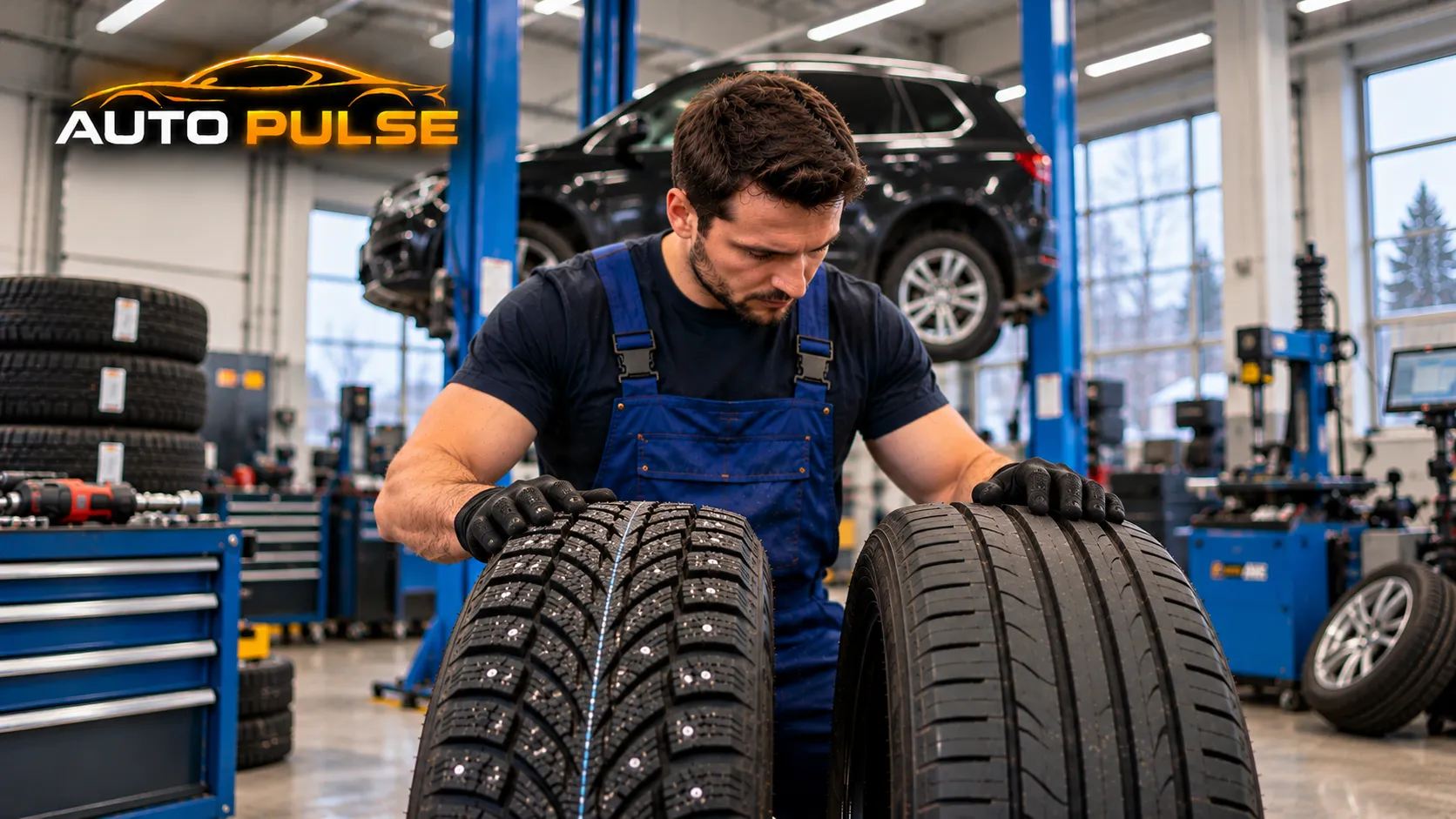
The climate in Tallinn and other Estonian cities imposes specific requirements on car tires. Frequent thaws are followed by frosts, slush appears on the roads, and cleared asphalt can unexpectedly turn into icy patches.
Therefore, choosing tires for city driving in Estonia depends not only on the season but also on routes, mileage, driving style, and road conditions.
Which winter tires are better to choose for Tallinn — studded or friction (studless) tires? Are all-season models suitable? What should you pay attention to when buying summer tires?
In this article, the Auto Pulse specialists will discuss the features of different tire types, Estonian legislative requirements, and ways to extend the service life of your wheels.
Winter Tires for the City: Studded, Friction, or All-Season?
In winter, Tallinn can present completely different road conditions.
Central highways are usually cleared faster, whereas in courtyards, parking lots, and secondary roads, snow and ice can persist significantly longer.
When choosing winter tires, it is necessary to consider the exact conditions in which the vehicle is used most often.
Studded Tires: When They Are Truly Needed in the City
Studded winter tires are equipped with metal elements that help improve traction on ice.
They can be particularly useful when driving on icy roads and sections with densely packed snow.
You should consider studded tires if you:
- Regularly drive through uncleared courtyards.
- Frequently travel outside of Tallinn.
- Drive early in the morning when black ice is possible.
- Use rural roads with winter surfaces.
- Frequently encounter icy inclines and declines.
However, studded tires have their peculiarities.
On cleared asphalt, they typically create more noise, and the metal studs contribute to road surface wear.
Braking performance on dry and wet asphalt depends on the specific model: it cannot be stated that any studded tires always brake worse than non-studded ones.
If most of your trips are on cleared city streets, it is worth comparing high-quality studded and friction models based on independent test results.
Friction Tires (Studless): Scandinavian and European Types
Friction winter tires do not have metal studs. Their traction is provided by the rubber compound composition, construction, and tread pattern.
Conventionally, such tires can be divided into two main types.
Scandinavian friction tires are designed primarily for cold winter conditions, snow, and ice.
They typically feature a soft rubber compound and a construction oriented towards traction at low temperatures.
European friction tires are more often developed with an emphasis on wet and cold asphalt, rain, slush, and moderately snowy conditions.
For city driving in Tallinn, European models can be convenient due to their good performance on wet surfaces and acoustic comfort.
However, there is an important nuance.
In Estonia, black ice frequently occurs after thaws. On such surfaces, Scandinavian friction tires, especially models with proven ice traction characteristics, may be preferable to European ones.
Which type to choose?
If you predominantly drive on cleared wet asphalt, you can consider European winter tires.
If you regularly encounter snow, ice, and early morning frosts, it is worth paying attention to Scandinavian friction models.
It is better to make the final choice based on the test results of specific tires, rather than solely on their category.
All-Season Tires in Estonia: Advantages, Disadvantages, and Legal Requirements
All-season tires allow you to use one set throughout the entire year.
This is convenient for drivers who have a low annual mileage and predominantly drive within the city.
Advantages of all-season tires:
- No need to change the set twice a year.
- No need to store a second set of wheels.
- Convenient in moderate weather conditions.
- Can be an economical solution for low mileage.
However, all-season tires represent a compromise.
In severe frost and on ice, they may be inferior to specialized winter models, and in summer — to high-quality summer tires.
Can You Drive on All-Season Tires in Winter in Estonia?
Yes, if they meet the current technical requirements.
During the mandatory winter period, from December 1 to March 1, standard non-studded winter and all-season tires must have the 3PMSF marking — an image of three mountain peaks with a snowflake.
The M+S marking alone is not sufficient.
The minimum allowable tread depth for winter tires is 3 mm.
Therefore, when purchasing an all-season set, it is necessary to check for the 3PMSF marking and compliance with the vehicle’s other requirements.
For more details on markings, read the article “Winter Tire Markings in Estonia: M+S and 3PMSF”.
Summer Tires for the City: What to Pay Attention to When Choosing
Estonian summers are accompanied not only by warm weather but also by heavy rains.
Therefore, when choosing summer tires for city use, it is important to consider wet asphalt traction, resistance to hydroplaning, wear resistance, and noise level.
Wet Road Traction and Hydroplaning Protection
Hydroplaning occurs when a layer of water forms between the tire and the road surface.
In such a situation, the tire may partially or completely lose contact with the road.
The risk depends on speed, water depth, tread condition, and tire construction.
When choosing summer tires, pay attention to:
- Wet asphalt braking test results.
- Resistance to hydroplaning.
- The design of water evacuation grooves.
- Remaining tread depth.
- Size compatibility with the vehicle.
Wide longitudinal grooves can facilitate water evacuation, but the quality of a tire cannot be reliably determined by the appearance of the tread pattern alone.
It is better to rely on independent tests and the characteristics of the specific model.
Tire Wear Resistance in City Driving
City driving involves frequent stops, accelerations, turns, and braking.
Such conditions can accelerate tire wear.
When purchasing, it is worth considering the durability of the rubber compound and wear test results.
Some tires feature a Treadwear rating, which relates to wear resistance classification.
However, Treadwear values from different manufacturers do not always allow for a correct comparison of the actual tire lifespan.
Therefore, you should not choose a set based solely on a rating of 300 or 350.
A more reliable approach is to consider comparative test results, manufacturer recommendations, and real-world operating conditions.
Noise Level and Comfort
For city driving, comfort also matters.
Some tire models feature a tread pattern designed to reduce rolling noise.
When choosing, you can refer to the European tire labeling, which indicates the external noise level.
However, noise outside the vehicle and noise inside the cabin are not the same thing.
Acoustic comfort is also influenced by the road surface, vehicle construction, and sound insulation.
How to Extend Tire Service Life: Four Tips from Auto Pulse
Even high-quality tires can wear out faster than expected if basic operating rules are not followed.
1. Regularly Check Tire Pressure
Insufficient pressure increases tire deformation, can cause overheating, and accelerates wear on the tread shoulder areas.
Excessive pressure can also negatively affect comfort, traction, and wear patterns.
Check the pressure at least once a month and before long trips.
Measurements are best taken on cold tires.
Use the values recommended by the vehicle manufacturer. They are usually indicated on the driver’s door jamb, the fuel filler flap, or in the owner’s manual.
2. Follow Tire Rotation Recommendations
Front and rear tires can wear at different rates.
This depends on the drive type, weight distribution, suspension features, and driving style.
For some vehicles, tire rotation is recommended approximately every 10,000–15,000 km.
However, the exact interval and permissible rotation pattern are determined by the vehicle and tire manufacturers.
On vehicles with different wheel sizes on the front and rear axles, standard rotation may not be possible.
It is also necessary to consider the directional tread pattern.
3. Store Seasonal Tires Properly
Improper storage can contribute to tire aging and deformation.
It is recommended to choose a dry, cool room without direct sunlight and exposure to aggressive chemicals.
Tires on rims can usually be stored horizontally in a stack or hung by the rims.
Tires without rims are recommended to be stored vertically, periodically changing their position.
Before storage, it is advisable to clean the wheels of dirt, dry them, and check for any damage.
4. Do Not Ignore Wheel Balancing
Wheel imbalance can manifest as vibrations in the steering wheel or vehicle body at a certain speed.
The cause may be lost balancing weights, rim damage, or uneven mass distribution.
If vibrations occur, it is recommended to have the wheels checked.
Balancing helps eliminate imbalance, but does not correct deform