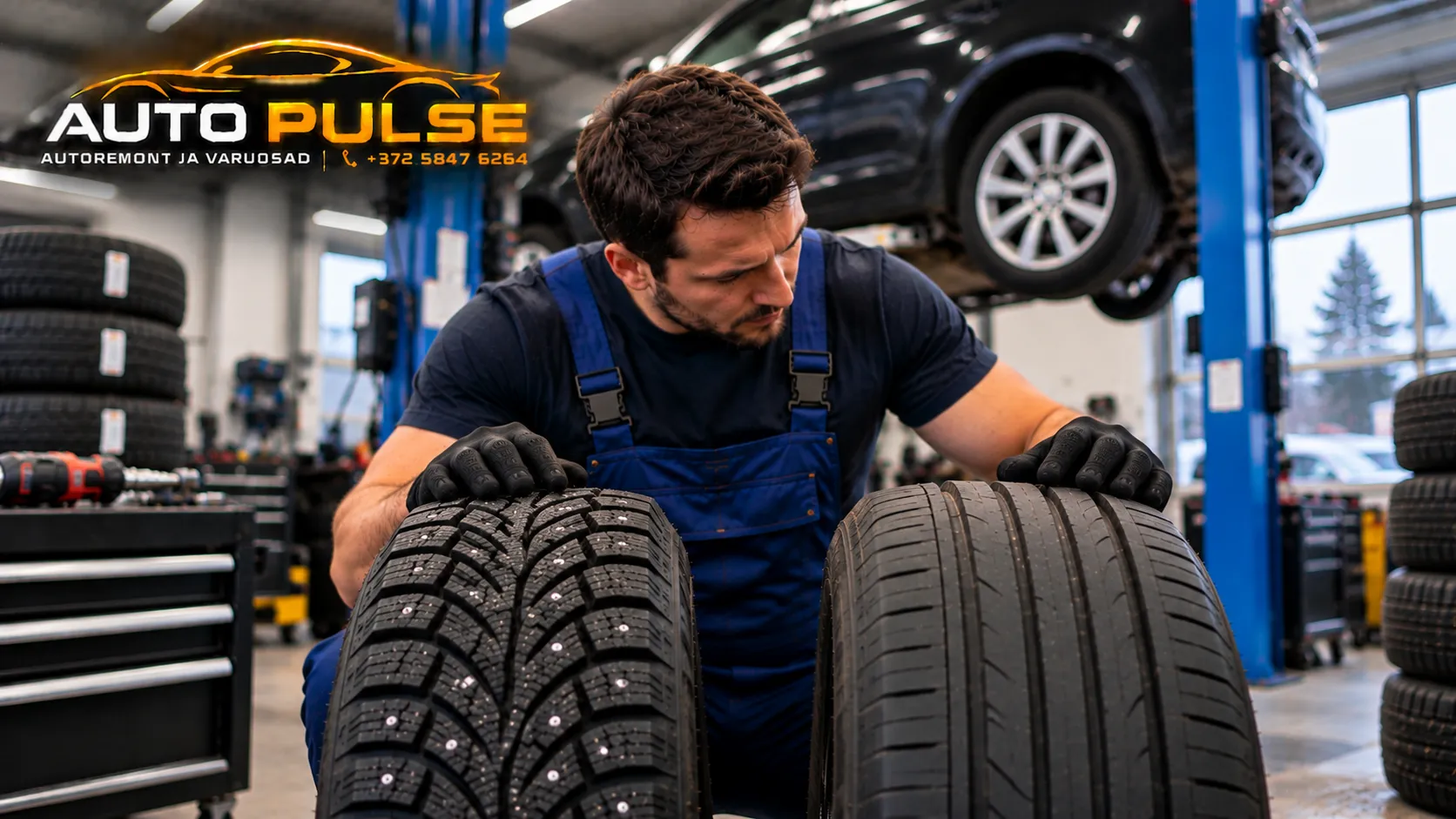
Can you put different tires on the same axle? This question regularly arises among car owners after a puncture, purchasing a used car, or when trying to save money on seasonal tire changes.
At first glance, it seems that if the tire diameter and width match, there should be no problems. However, different models can vary in rubber compound composition, tread pattern, sidewall stiffness, and grip characteristics.
In the changeable weather conditions of Tallinn, where rain can quickly turn into black ice, predictable vehicle behavior is especially important.
Improperly selected tires can worsen handling, affect braking, and in some cases, create additional stress on the transmission.
Let us examine the technical and legal aspects of the issue so you can make the right decision.
Can you put different tires on the same axle: a short answer
On a single vehicle axle, it is necessary to use tires that comply with established requirements regarding size, construction, and tread pattern.
Installing incompatible tires may violate Estonian technical requirements and create safety risks.
Using different models on the front and rear axles is permissible in certain cases, provided that the vehicle manufacturer’s requirements and legislation are observed.
When selecting tires, it is necessary to consider:
- Size.
- Construction.
- Tread pattern.
- Seasonal purpose.
- Residual tread depth.
- Load and speed indices.
- Vehicle drivetrain type.
The preferred option for most vehicles is a set of four identical tires, unless the manufacturer specifies a different configuration.
Why different tires on the same axle are dangerous
Differences between tires can become apparent during braking, cornering, and driving on wet surfaces.
Let us consider the main risks.
Impact on handling and braking distance
Each tire model is developed with a specific tread pattern and rubber compound composition.
These characteristics affect grip on dry asphalt, water, snow, and ice.
If significantly different tires are installed on the same axle, one wheel may provide better grip than the other.
During emergency braking or a sharp maneuver, the vehicle may react less predictably.
Particular caution is required when driving on:
- Wet asphalt.
- Icy roads.
- Packed snow.
- Deep ruts.
- Surfaces with uneven coverage.
A difference in tread pattern can affect the tires’ ability to displace water and resist hydroplaning.
At the same time, the degree of risk depends on the specific tire models, their condition, and road conditions.
Risk to ABS and ESP systems
Modern vehicles are equipped with electronic safety systems.
ABS helps prevent wheel lock-up during braking.
ESP helps maintain vehicle stability in the event of a skid or other deviations from the intended trajectory.
These systems rely on sensor data, including wheel rotation speed.
If the tires differ significantly in effective rolling circumference, the wheels may rotate at different speeds even when the vehicle is traveling at a constant speed.
On some vehicles, a significant mismatch in tire sizes can affect the operation of electronic systems and trigger diagnostic errors.
However, a slight difference in tread depth does not mean automatic deactivation of ABS or ESP.
Permissible deviations depend on the vehicle’s design.
Therefore, when selecting tires, it is necessary to comply with the manufacturer’s requirements regarding dimensions and the permissible difference in rolling circumference.
Uneven wear and increased transmission load
Differences in the effective wheel diameter can affect the operation of the differential.
The differential allows the wheels to rotate at different speeds, for example, when cornering.
However, a constant, significant difference in rolling circumference on some vehicles can create additional stress on transmission components.
This is especially important for certain all-wheel-drive systems.
At the same time, it cannot be stated that any different tire models will inevitably lead to differential overheating or suspension damage.
The risk depends on the vehicle’s design and the actual difference in wheel parameters.
Wheel balancing helps eliminate wheel imbalance, but it does not fix tire incompatibility in terms of construction or grip characteristics.
Different tires on the front and rear axles: is it permissible?
In certain situations, installing different tire models on the front and rear axles is permissible.
For example, if a compatible pair is installed on each axle and the entire set meets the vehicle’s technical requirements.
However, it is necessary to consider the grip characteristics of the front and rear wheels.
Why is it recommended to install the best tires on the rear axle?
When replacing only two tires, many manufacturers recommend installing the pair with better grip on the rear axle.
This is related to vehicle stability.
If the rear wheels lose grip before the front ones, oversteer and skidding may occur.
Controlling a rear-axle skid is often more difficult than controlling front-axle understeer.
Therefore, installing tires with better grip characteristics on the rear helps reduce the risk of losing stability.
This recommendation applies to many front-wheel-drive and rear-wheel-drive vehicles.
However, it is necessary to consider the specifics of the particular model and the manufacturer’s recommendations.
When is tire rotation between axles not possible?
Some vehicles use different front and rear wheel sizes.
This configuration is provided for by the vehicle’s design.
In this case, rotating tires between axles may be impermissible.
It is also necessary to consider the directional tread pattern and the markings of asymmetric tires.
What does the law say about tires in Estonia in 2026?
In Estonia, requirements for vehicle tires are regulated by the technical condition standards for motor vehicles.
They are taken into account during vehicle operation and when passing the technical inspection — ülevaatus.
Basic tire requirements
When installing tires, it is necessary to consider:
- Size.
- Construction.
- Tire compatibility on the same axle.
- Tread pattern.
- Load and speed indices.
- Seasonal requirements.
- Minimum tread depth.
If the installed tires do not comply with applicable technical requirements, this may result in remarks or a failed technical inspection.
Operating a vehicle in violation of technical requirements may also entail liability under the law.
Minimum tread depth
For standard passenger cars, the main minimum values are as follows:
- Summer tires — 1.6 mm.
- Winter tires during the mandatory winter period — 3 mm.
However, the minimum permissible depth does not always ensure optimal grip characteristics.
For regular driving on wet asphalt, it is recommended to consider replacing summer tires when the residual depth is around 3 mm.
For winter tires used in snow and slush, a practical benchmark for replacement is around 4–5 mm.
Current requirements can be checked on the official resources of Transpordiamet and Riigi Teataja.
For more details on seasonal requirements, read the article “When to change winter tires to summer tires in Estonia”.
Four scenarios: what to do if you already have different tires installed
Let us consider common situations and possible solutions.
Scenario 1. Damage to a single tire
If one tire has suffered a puncture or other damage, it is first necessary to determine if repair is possible.
Some punctures in the repairable area of the tread can be fixed without purchasing a new tire.
However, sidewall damage, bulges, or carcass destruction may render the tire unfit for repair.
If replacement is necessary, it is desirable to select an identical model of the appropriate size.
At the same time, it is necessary to assess the condition of the second tire on the same axle.
If it is practically new and the difference in wear complies with the manufacturer’s requirements, replacing a single tire may be permissible.
If the second tire is significantly worn, it is recommended to consider replacing the pair.
Before visiting a service center, you can read the article “How much does tire service cost in Tallinn”.
Scenario 2. Purchasing a used car with different tires
When purchasing a used car, it is important to check all four wheels.
Especially if different models are installed on the same axle.
Check:
- The size of each tire.
- The manufacturer and model.
- The residual tread depth.
- The manufacturing date.
- The presence of cracks and damage.
- The uniformity of wear.
- Compliance with seasonal requirements.
Uneven wear may be related to incorrect pressure, misaligned wheel angles, or suspension malfunctions.
If the vehicle pulls to one side, vibrations have appeared, or pronounced uneven wear is noticeable, it is recommended to undergo diagnostics.
For more details on possible malfunctions, read the article “Car suspension knocking: main causes