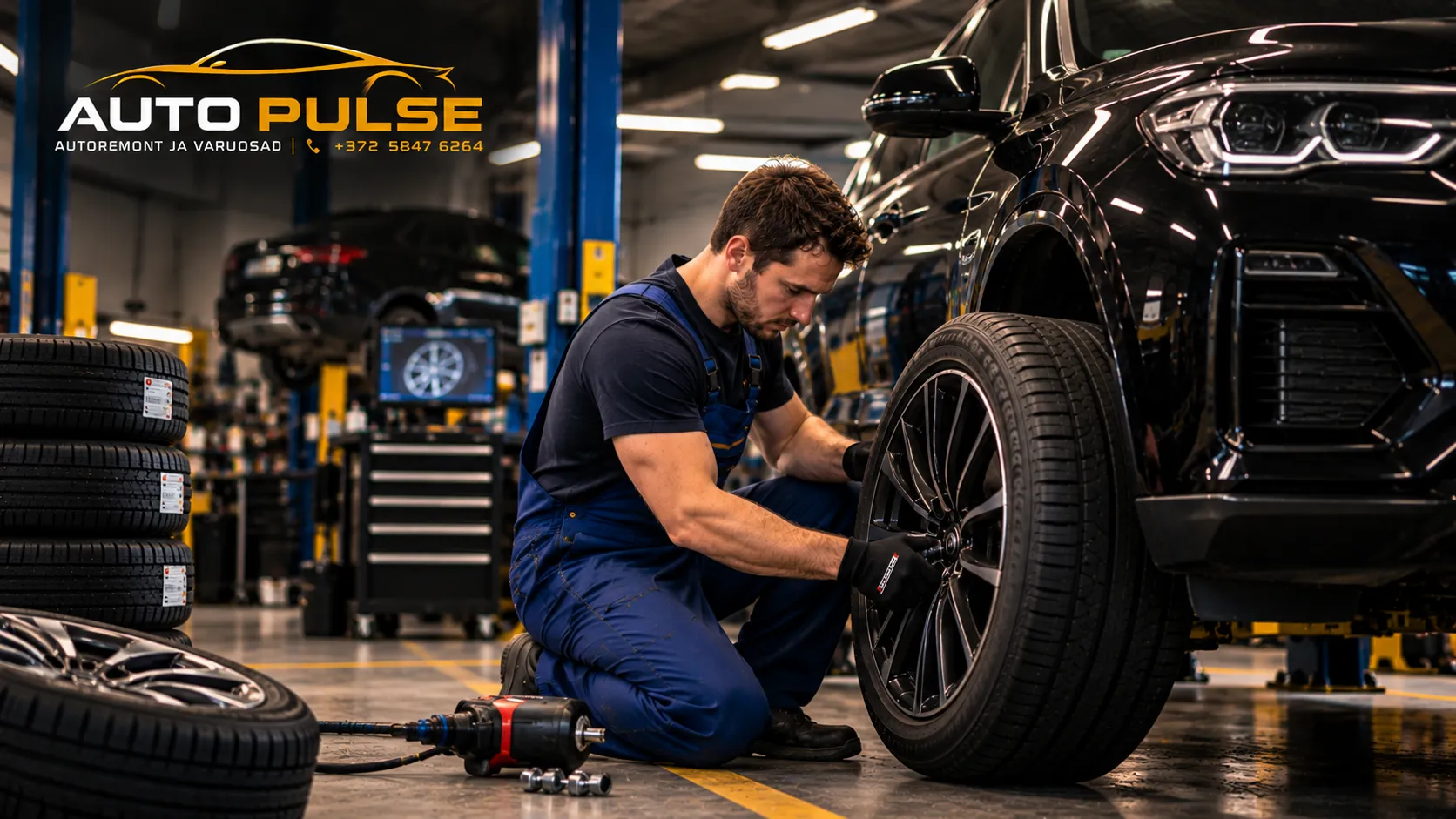
Owners of crossovers and SUVs in Tallinn often notice that seasonal tire replacement on their vehicles costs more than on smaller passenger cars. Why does this difference occur? It is not necessarily due to the vehicle category or its price.
The cost of SUV tire fitting depends primarily on the size and weight of the wheels, tire construction, mounting complexity, and the scope of required work.
Wheels of modern crossovers often have a diameter of R18–R22, wide tires, and a low profile. Some models are equipped with RunFlat technology and TPMS pressure sensors. All of this requires careful handling and appropriate equipment.
Let us break down what makes up the cost of tire fitting for SUVs in Tallinn, what operations are included in a complete tire change, and where you can save money without compromising safety.
Why SUV tire fitting can cost more than for a regular passenger car
To understand the price difference, it is necessary to consider the technical features of crossover and SUV wheels.
At the same time, it is important to understand: not every SUV automatically requires more expensive maintenance. A compact crossover with standard R16 tires might be easier to work on than a passenger car with low-profile R20 tires.
Therefore, it is more accurate to focus on the wheel size, tire type, and the list of operations.
Vehicle weight and wheel dimensions
Large crossovers and SUVs are often equipped with wide tires and heavy alloy wheels.
A large-diameter wheel can weigh significantly more than a standard wheel of a compact car.
This affects the maintenance process:
- a heavy wheel is more difficult to remove and install;
- it must be properly secured on the equipment;
- wide tires require careful handling during mounting;
- some operations take more time.
The difference is especially noticeable when working with R19, R20, R21, and R22 wheels.
However, the vehicle weight alone does not determine the cost of tire fitting. The actual wheel specifications and maintenance requirements are more important.
Specifics of RunFlat and low-profile tires
Some modern SUVs come with low-profile tires or tires featuring RunFlat technology.
RunFlat allows you to continue driving for a limited distance and at a limited speed after a loss of pressure, under certain conditions. The specific limitations are set by the tire manufacturer.
Such tires may have reinforced sidewalls, which complicates mounting and dismounting.
To work with them, it is important to use a suitable tire changer, auxiliary tools, and special mounting materials.
Improper handling of a stiff tire can lead to damage to its bead or the wheel surface.
Therefore, when booking a tire fitting service, it is worth mentioning in advance if your vehicle is equipped with RunFlat.
TPMS pressure sensors
Many modern vehicles are equipped with a tire pressure monitoring system — TPMS.
There are two main types of systems:
- Direct TPMS — uses pressure sensors installed directly in the wheels.
- Indirect TPMS — evaluates changes in wheel rotation parameters using the vehicle’s systems.
With direct TPMS, the sensor is often located inside the wheel next to the valve.
During tire dismounting and mounting, its location must be taken into account to avoid damaging the electronic component.
After maintenance, some vehicles may also require a sensor initialization or registration procedure.
The presence of TPMS does not always increase the cost of the work, but it can affect its complexity and the list of necessary operations.
What makes up the cost of SUV tire fitting
The cost of a complete tire change depends on the specific set of works.
For the vehicle owner, it is important to understand what is included in the stated price and which operations may be charged separately.
Wheel dismounting and mounting
The first step is removing the wheels from the vehicle.
The technician checks the fasteners, removes the wheels, and if necessary, cleans the contact surfaces.
In Estonian conditions, special attention is paid to the condition of the fasteners and hubs.
Moisture, salt, and de-icing materials can contribute to the corrosion of metal elements.
Sometimes a wheel is difficult to remove from the hub due to corrosion on the contact surfaces. In such cases, additional time is required for safe dismounting.
After that, the old tire is removed from the rim and another one is mounted.
When working with large alloy wheels, it is important to use equipment and techniques that minimize the risk of damage.
Balancing of large-diameter wheels R19–R22
After mounting the tire on the rim, the assembled wheel is balanced.
It is necessary to compensate for imbalance, which can cause vibrations during driving.
For large wheels, the following are especially important:
- proper centering on the balancing machine;
- equipment compliance with the wheel size and weight;
- precise determination of weight positions;
- secure attachment of balancing weights;
- verification of the result after balancing.
For alloy wheels, adhesive weights can be used, including those placed behind the spokes.
Important: during seasonal replacement of complete assembled wheels, rebalancing is not always required. However, after mounting new tires on rims, balancing is necessary.
Valve replacement and additional work
During tire changing, the technician also assesses the condition of the valves.
Over time, rubber elements can age, lose elasticity, and leak.
If a valve is damaged or shows signs of wear, it may need to be replaced.
For wheels with TPMS sensors, appropriate components and service kits are used.
However, installing metal valves is not mandatory for every SUV. The valve type must match the wheel design and the manufacturer’s requirements.
Additional work may also include:
- puncture repair, if technically feasible;
- maintenance of TPMS components;
- cleaning of contact surfaces;
- replacement of damaged fasteners;
- other operations agreed upon with the vehicle owner.
This is exactly why it is useful to clarify which works are included in the base cost before maintenance begins.
Cost of SUV tire change at Auto Pulse — Tallinn
At Auto Pulse, when selecting a tire fitting service, wheel specifications and the required scope of work are taken into account.
For example, a complete change of four wheels may include removing the wheels from the vehicle, dismounting old tires, mounting other tires, balancing, and reinstalling.
However, the final cost depends on the wheel size, tire construction, and possible additional operations.
| Parameter | How it affects the cost |
| Diameter R17–R18 | Usually a standard scope of work |
| Diameter R19–R20 | More labor-intensive operations are possible |
| Diameter R21–R22 | Requires equipment designed for corresponding sizes |
| Low-profile tires | Mounting may be more complex |
| RunFlat | May require special equipment and more time |
| TPMS | Sensor design must be taken into account |
| Damaged fasteners or corrosion | Additional work may be required |
| Tire repair | Assessed separately if necessary |
The exact price is determined by the current price list and the chosen service.
You can view the available options in the “Auto Pulse Tire Services” section.
To compare rates for different wheel sizes, we recommend reading the article “How much does tire service cost in Tallinn”.
How to save on crossover tire fitting without losing quality
You can reduce seasonal maintenance costs without skipping necessary technical operations.
Book in advance
At the beginning of the tire change season, demand for tire fitting services increases significantly.
If you plan your visit in advance, it is easier to choose a convenient time and avoid long waits.
This is especially relevant for SUV owners with non-standard tire sizes or RunFlat technology.
When booking, it is advisable to immediately provide:
- the make and model of the vehicle;
- tire size;
- presence of RunFlat;
- whether tire changing or complete wheel replacement is needed;
- any damage requiring attention.
This will allow determining the appropriate scope of work in advance.
Consider a second set of rims
If the vehicle is used for a long time, separate sets of summer and winter wheels can be a convenient solution.
In this case, the seasonal change does not require removing tires from rims every time.
Replacing complete assembled wheels is usually faster and can be cheaper than a single full tire change.
However, the initial cost of a second set of rims and possible TPMS sensors must be taken into account.
Check tire condition before the season starts
Before booking, it is useful to inspect the tires you plan to install.
Check:
- tread depth;
- absence of cracks and bulges;
- sidewall condition;
- uniformity of wear;
- absence of visible rim damage.
If the set is no longer suitable for safe operation, it is better to find this out in advance rather than directly during the seasonal change.
Clarify the full cost of the service
When comparing offers from different auto repair shops, it is important to consider not only the starting price.
Clarify whether it includes wheel removal and installation, tire changing, balancing, and necessary consumables.
Also ask if there is an additional cost for RunFlat, large diameters, or specific TPMS operations.
This way, you can compare the actual service conditions, not just the advertised rates.
FAQ: Frequently Asked Questions
How long does it take to change four SUV wheels?
Approximately, a complete tire change and balancing of four large-diameter wheels can take 60–90 minutes.
When working with RunFlat, low-profile tires, or in the presence of technical difficulties, the duration may increase.
It is better to clarify the exact time when booking.
Is balancing included in the cost of a complete tire change?
A complete tire change usually implies wheel balancing after tire mounting.
However, the composition of the specific service should be checked in the current auto repair shop price list.
Can an SUV weighing over 2000 kg be serviced at a regular tire shop?
The possibility of servicing depends on the lifting capacity of the equipment, the vehicle design, and the permissible parameters of the tire changers.
Before booking, owners of heavy SUVs and vans are advised to provide the exact vehicle model.
Is it mandatory to change valves with every tire change?
Not in all cases.
The need for replacement depends on the valve type, its condition, and the manufacturer’s recommendations.
Rubber valves are checked for aging and damage, and TPMS components are serviced according to their design.
Why can R20 tire fitting cost more than R17?
R20 wheels are often heavier, wider, and equipped with stiffer or low-profile tires.
Their mounting may require more time and special tools.
However, the final cost depends not only on the diameter, but on the entire wheel construction and the scope of work.
Conclusion
The cost of SUV tire fitting in Tallinn depends on the technical features of the vehicle and the wheels.
Large rim diameters, low-profile tires, RunFlat technology, and TPMS sensors can increase the complexity of maintenance.
Therefore, when choosing an auto repair shop, it is important to consider not only the price, but also the availability of suitable equipment, compliance with mounting technology, and the transparency of the list of works.
At Auto Pulse, you can clarify the suitable tire fitting service for your crossover or SUV and agree on a convenient time for your visit.
Auto Pulse — Pae 28, Tallinn
Phone: +372 5847 6264