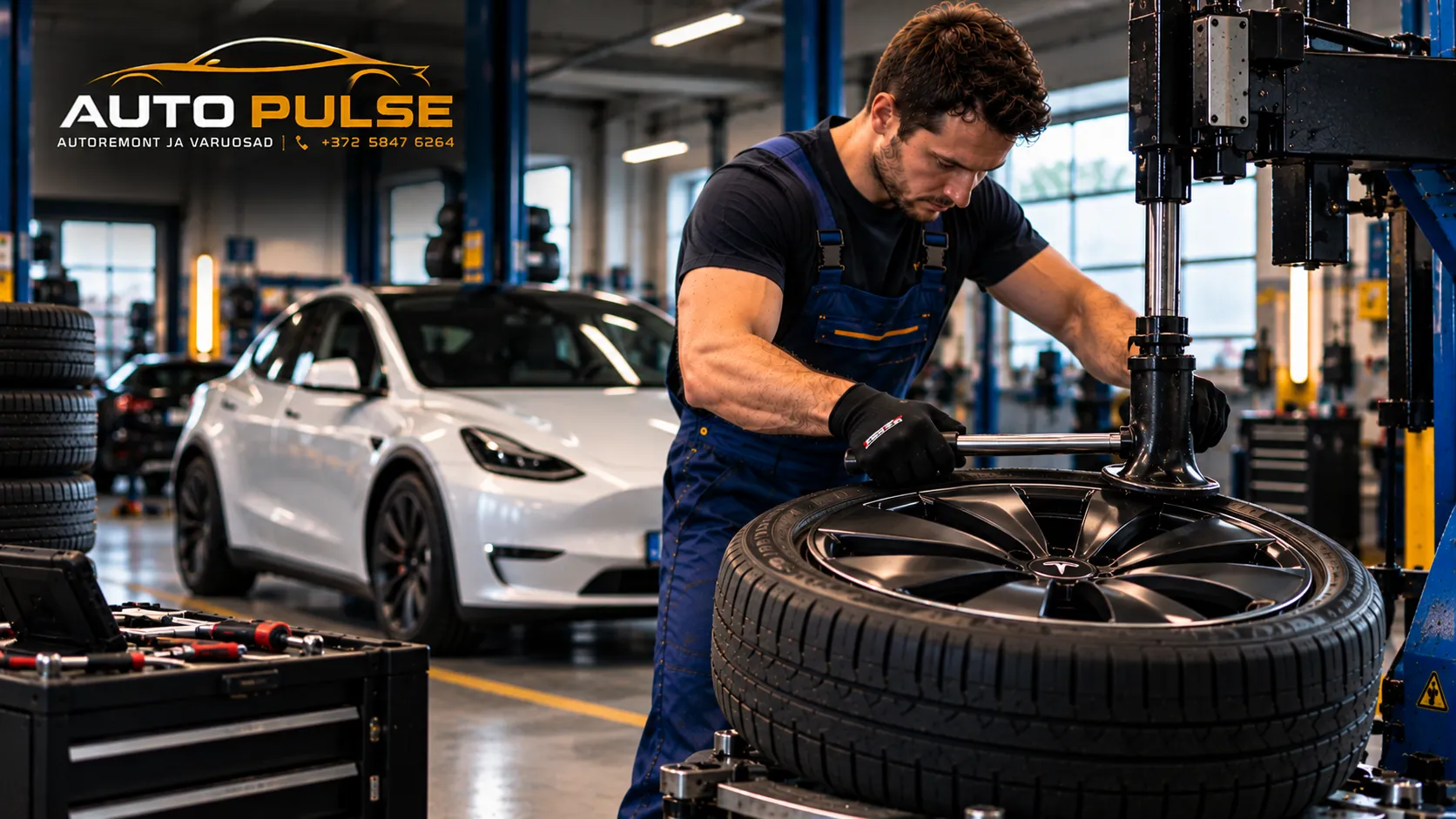
Electric vehicles are increasingly common on the roads of Tallinn. Tesla, Volkswagen ID.4, Hyundai Ioniq, and Kia EV6 have already become familiar participants in urban traffic. But when the time comes for seasonal tire changes, owners have questions: is EV tire fitting different from servicing a regular car, are special tires needed, and can a standard lift be used?
In most cases, the main operations are the same. However, the design of an electric vehicle has specific features that must be taken into account when working with wheels.
The increased weight of some models, high torque, special tires with acoustic foam, pressure sensors, and the location of the traction battery — all of this requires a careful approach.
In this article, Auto Pulse discusses five important features of EV tire fitting in Tallinn that will help you properly prepare your vehicle for service.
1. EV Weight and Increased Tire Load
One of the features of electric vehicles is the presence of a traction battery, which can significantly increase the vehicle’s weight.
Compared to a gasoline or diesel car of a similar class, some electric vehicles turn out to be heavier.
At the same time, the electric motor is capable of delivering high torque almost immediately after starting to move.
This creates certain specific conditions for tire operation.
Why EV Tires May Wear Out Faster
Tire lifespan is influenced by a combination of several factors:
- vehicle weight;
- acceleration intensity;
- tire pressure;
- rubber compound composition;
- suspension condition;
- wheel alignment angles;
- road surface quality.
With frequent sharp accelerations, the tread can wear out faster. This is especially true if the vehicle is heavy and the driver regularly utilizes the electric motor’s high torque.
However, it is incorrect to claim that the tires of any electric vehicle will necessarily wear out 20–30% faster. The actual lifespan depends on the vehicle model, tire design, and operating conditions.
Recommendation: regularly check the tread depth, pressure, and wear uniformity. If one side of the tire wears out faster than the other, the cause must be identified.
XL and HL Markings: What They Mean
When choosing tires for an electric vehicle, special attention must be paid to the load index.
Some tires feature additional markings:
XL (Extra Load) — a reinforced category of tires designed for increased load under specified operating conditions.
HL (High Load) — a category of tires with increased load capacity for certain sizes.
Such tires can be used on heavy vehicles, including electric ones.
However, not every electric vehicle necessarily requires tires with HL or XL markings.
The main thing is compliance with the specific vehicle manufacturer’s requirements.
Before purchasing, you must check:
- tire size;
- load index;
- speed index;
- permissible wheel sizes;
- additional manufacturer recommendations.
Unsuitable tires can negatively affect handling, safety, and wheel lifespan.
2. Tires with Acoustic Foam and Self-Sealing Layer
Electric vehicles typically feature a lower noise level from the powertrain.
Because of this, tire rolling noise becomes more noticeable.
To enhance acoustic comfort, some manufacturers use special technologies.
Why Acoustic Foam is Installed Inside the Tire
In certain tire models, a special layer of acoustic material is attached to the inner surface.
It helps reduce specific noise components generated while the vehicle is in motion.
Such solutions are found in tires designed for various vehicles, including electric ones.
However, acoustic foam is not a mandatory element of every tire with an EV marking.
How Acoustic Foam Affects Tire Fitting
During standard tire mounting and dismounting, the mounting tool works primarily with the tire beads.
Therefore, properly performed mounting should not damage the acoustic foam located inside the tread area.
However, the presence of this layer must be taken into account when:
- inspecting the inner surface of the tire;
- repairing punctures;
- assessing the condition of the acoustic material;
- identifying the causes of unusual vibrations.
If the foam has peeled off or shifted, additional diagnostics may be required.
At the same time, damage to the acoustic layer does not always mean the tire needs to be completely replaced.
The decision depends on the nature of the defect and the manufacturer’s recommendations.
What Are Self-Sealing Tires
Some tires are equipped with a special sealing layer.
In the event of certain small punctures in the tread area, it can reduce air loss.
However, such technology does not protect against all types of damage.
Side cuts, large punctures, and internal damage to the tire structure can make further operation dangerous.
If damage is detected, the possibility of repair must be evaluated taking into account the manufacturer’s technology.
3. EV Wheel Balancing
Proper balancing is important for any vehicle.
It allows compensating for the uneven distribution of wheel mass and reducing vibrations while driving.
In an electric vehicle, some vibrations may be felt more distinctly due to the absence of the familiar internal combustion engine noise.
Why Vibrations Occur After Tire Fitting
The reasons can vary:
- improper centering of the wheel on the balancing machine;
- inaccurate placement of balancing weights;
- damage or deformation of the rim;
- tire defect;
- uneven tread wear;
- suspension issues.
If steering wheel or body vibration appears after a seasonal tire change, one should not automatically assume the cause is solely balancing.
Sometimes, an additional check of the wheel and vehicle condition is required.
Is It Necessary to Balance Wheels During Every Seasonal Change?
If tires are removed from the rims and reinstalled, balancing of the assembled wheels is necessary.
However, if you use two complete sets of wheels, rebalancing during every seasonal change is not always mandatory.
However, it is recommended to check it if vibrations occur, after wheel repair, or if a balancing weight is suspected to be lost.
You can learn more about the types of services in the “Auto Pulse Tire Service” section.
4. Correct Wheel Bolt Tightening Torque
After tire fitting, it is important not only to install the wheel correctly but also to tighten the fasteners to the torque specified by the vehicle manufacturer.
This is especially relevant for modern cars with alloy wheels, including electric vehicles.
Why You Should Not Tighten Wheels Only with an Impact Wrench
A pneumatic or electric impact wrench is convenient for performing mounting operations.
However, the final tightening of wheel fasteners must be controlled with an appropriate torque tool.
Insufficient tightening can lead to loose fasteners.
Excessive tightening can damage the threads, studs, or other connection elements.
Important: there is no universal tightening torque for all electric vehicles.
Tesla, Volkswagen, Hyundai, Kia, and other manufacturers may have different requirements.
Therefore, it is necessary to use the technical specifications of the specific model.
Is It Necessary to Recheck Fasteners After Tire Fitting?
Follow the recommendations of the vehicle and service manufacturer.
If a recheck of the fasteners is provided after a certain mileage, it must be performed.
You should not overtighten the bolts on your own without knowing the specified tightening torque.
5. Safe Lifting of an Electric Vehicle on a Lift
One of the most important features of EV servicing is the correct placement of the lift supports.
In many models, the traction battery is located at the bottom of the vehicle body.
Therefore, an incorrect choice of lifting points can lead to damage to vehicle components.
Why You Cannot Lift an EV in Arbitrary Places
Each manufacturer specifies special points intended for lifting the vehicle.
Depending on the model, additional adapters may be required.
Before starting work, you must ensure that:
- the designated lifting points are used;
- the supports do not contact the battery casing;
- the vehicle is correctly positioned on the lift;
- the manufacturer’s requirements are met;
- suspension features are taken into account.
What is Jack Mode
Some electric vehicles with adjustable air suspension are equipped with a special jack mode — Jack Mode.
It is designed to prevent automatic changes in suspension height during lifting.
For example, such a procedure is provided for certain Tesla configurations with air suspension.
However, not all electric vehicles have Jack Mode.
Also, it should not be confused with Transport Mode, which may be used for other tasks.
The correct procedure must be determined according to the specific vehicle manufacturer’s manual.
TPMS Pressure Sensors: What to Consider When Changing Tires
Many modern vehicles are equipped with a Tire Pressure Monitoring System (TPMS).
It helps the driver detect a drop in pressure.
Depending on the design, the system may use sensors inside the wheels or indirectly determine pressure changes.
If the sensor is located inside the wheel, it is important to consider its position during tire mounting and dismounting.
Improper use of the mounting tool can damage the sensor or valve.
After changing wheels, some vehicles may require a procedure to calibrate or re-identify the sensors.
Why Pressure is Especially Important for an Electric Vehicle
Incorrect pressure can affect:
- rolling resistance;
- driving range;
- handling;
- braking;
- tire wear uniformity.
Pressure should be checked according to the vehicle manufacturer’s recommendations.
There is no need to automatically increase pressure just because the vehicle is electric.
How Much Does EV Tire Fitting Cost in Tallinn
The cost of tire fitting depends primarily on the size and design of the wheels, as well as the required scope of work.
The final price can be influenced by:
- rim diameter;
- tire size;
- presence of low-profile tires;
- RunFlat design;
- the need for complete tire mounting and dismounting;
- wheel rim features;
- additional services.
The electric motor itself does not mean that tire fitting must necessarily cost more.
However, certain features of the tire or vehicle design may require additional time and equipment.
To find out approximate rates, read the article “How Much Does Tire Service Cost in Tallinn”.
Before booking, it is advisable to provide the make, model, year of manufacture, and wheel size.
This will help clarify the possibility of service and the cost in advance.
How to Prepare an Electric Vehicle for Tire Fitting
A little preparation will help avoid delays and additional questions during your service visit.
Pre-Booking Checklist
- Clarify the tire size. For example, 235/45 R18 or 255/40 R20.
- Check the load index. The new set must meet the vehicle’s requirements.
- Mention special tires. Indicate if RunFlat, acoustic foam, or self-sealing layer tires are installed.
- Check for the locking key. If the vehicle has locking bolts or nuts, prepare the corresponding adapter.
- Clarify suspension features. Especially if the vehicle is equipped with air suspension.
- Report TPMS warnings. If the system shows an error or pressure loss, warn about it in advance.
- Clarify the required service. Do you need a complete wheel set change or full tire mounting and dismounting?
This information will help the auto service determine the appropriate workflow.
Frequently Asked Questions (FAQ)
Are Special Rims Needed for an Electric Vehicle?
Not necessarily. However, the rims must meet the manufacturer’s requirements for size, offset, fastening parameters, and permissible load.
Using rims with unsuitable characteristics can affect the vehicle’s safety.
How Often Should Tires Be Changed on an Electric Vehicle?
There is no universal interval.
The lifespan depends on the vehicle’s weight, tire design, driving style, pressure, and suspension condition.
It is recommended to regularly monitor tread depth and follow the vehicle manufacturer’s recommendations.
Can Regular Tires Be Installed on an Electric Vehicle?
Yes, if they meet all the technical requirements of the specific model.
Special EV marking is not always mandatory.
The main thing is to correctly select the size, load index, speed index, and other necessary characteristics.
Can Tires with Acoustic Foam Be Repaired?
In some cases, yes.
However, the repair technology depends on the tire’s design and the nature of the damage.
Before repair, the manufacturer’s recommendations must be taken into account.
Is It Necessary to Enable Jack Mode on Every Electric Vehicle?
No.
This mode is only available on certain models and configurations.
When lifting, it is necessary to follow the procedure established by the vehicle manufacturer.
Does Auto Pulse Work with Tesla, Volkswagen ID.4, and Hyundai Ioniq?
The possibility of tire fitting for a specific model should be clarified in advance.
When contacting us, please provide the make, model, year of manufacture, wheel size, and suspension features.
This will allow us to check the vehicle’s compatibility with the equipment and agree on the necessary work.
Conclusion
EV tire fitting requires attention to several technical features.