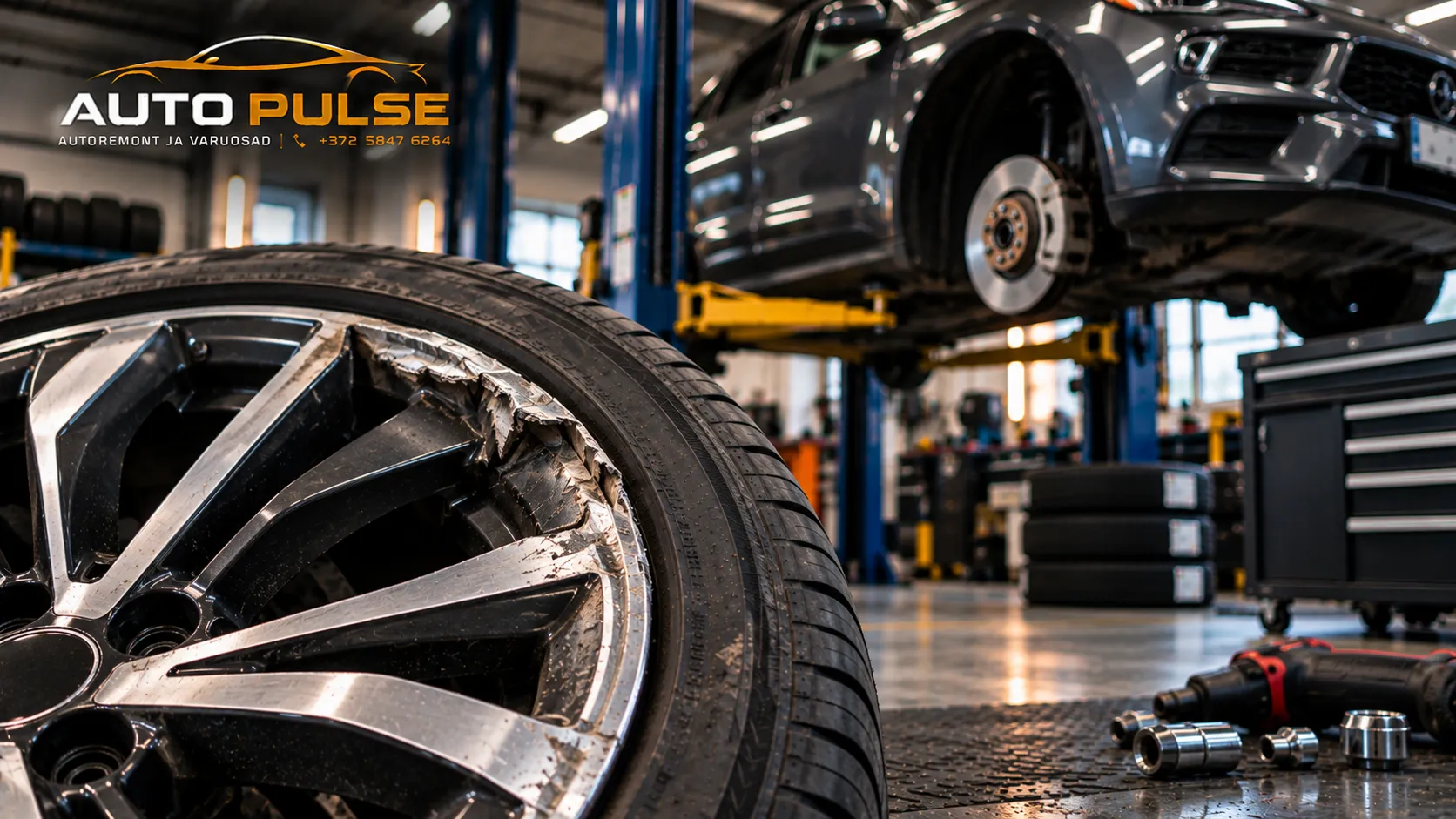
Driving on the roads of Tallinn and other cities in Estonia sometimes brings unpleasant surprises. A deep pothole hidden under a puddle, uneven road surfaces, or high curbs in parking lots can cause severe impacts to your wheels.
After such an incident, the driver may notice steering wheel vibration, unusual noise, decreased tire pressure, or visible damage to the rim.
A natural question arises: what should you do if your car wheel is damaged, can you continue driving, and is it mandatory to buy a new wheel?
The answer depends on the nature of the damage.
A small surface scratch usually does not pose an immediate danger. However, rim deformation, cracks, and damage to the tire seating surface can seriously affect vehicle safety.
In this guide, the specialists at Auto Pulse explain what types of wheel damage are most common, how to recognize dangerous signs, and when repair is possible versus when it is safer to replace the wheel.
Types of Wheel Damage: When to Repair and When to Replace
Not every instance of wheel damage requires replacement.
However, the decision regarding repairability must take into account the wheel material, the location of the defect, and its impact on structural strength.
Let’s consider the most common situations.
1. Rim Deformation — Bent Wheel
One of the most frequent problems after hitting a pothole is rim deformation.
During a strong impact, the edge of the wheel may change shape. Sometimes the damage is clearly visible from the outside, but often it is located on the inner side of the wheel.
Specifics depend on the wheel design.
Stamped Steel Wheels
Steel wheels typically have sufficient ductility and may deform upon impact without cracking.
Some steel wheel damages allow for professional restoration after assessing their condition.
Cast Alloy Wheels
Cast alloy wheels can be more sensitive to certain impact loads.
Under severe stress, both rim deformation and cracking may occur.
Therefore, before deciding on repair, it is important to check the structural integrity of the wheel.
How to Tell If Your Wheel Is Bent?
The most characteristic signs include:
- steering wheel vibration at specific speeds;
- shaking felt through the body;
- uneven wheel rotation;
- slow loss of pressure;
- visible deformation of the wheel edge.
Note that vibration is not always caused by wheel damage.
Similar symptoms can arise from improper balancing, tire damage, or suspension issues.
Diagnostics are required to determine the cause.
2. Cracks and Chips in the Wheel
Cracks are among the most dangerous types of wheel damage.
They may appear after a strong impact, especially if the load was concentrated on the rim edge or another stressed part of the structure.
Special attention is required for cracks:
- in the spoke area;
- near the center of the wheel;
- around mounting holes;
- on the tire seating surface;
- at joints between structural elements.
If a crack is detected on the wheel, stop using the vehicle with that wheel until a professional assessment is performed.
Even a small crack can grow under repeated loads.
Can You Weld a Cracked Cast Alloy Wheel?
Some workshops offer aluminum wheel welding services.
However, the technical ability to perform a weld does not mean the repaired wheel will be safe for continued use.
Welding can alter material properties in the heated zone and affect structural strength.
For many alloy wheel damages, manufacturers recommend replacement rather than structural repair.
Attempts to restore cracks in spokes, mounting zones, and other critical areas are particularly dangerous.
The safest solution for a structural crack is to replace the wheel with a compliant one that meets vehicle requirements.
3. Scratches, Coating Chips, and Corrosion
Not all damages involve geometric distortion.
For example, contact with a curb can cause the following on the wheel surface:
- scratches;
- scuffs;
- paint chips;
- clear coat damage;
- oxidation marks.
Such defects are often referred to as “curb rash.”
If only the decorative coating is damaged and the wheel structure is unaffected, the issue is usually cosmetic.
However, deep scratches and chips require additional evaluation.
In Estonian conditions, damaged coatings can promote corrosion due to exposure to moisture and road de-icing agents.
It is especially important to monitor the condition of the wheel seating surface.
If corrosion develops where the tire contacts the rim, seal integrity may be compromised, leading to gradual pressure loss.
Can You Drive With a Damaged Wheel?
The answer depends on the nature of the defect.
Driving is usually possible with minor surface scratches that do not affect wheel strength or geometry.
However, continuing normal operation is dangerous if there is deformation, cracking, air leakage, or significant vibration.
Why a Bent Wheel Can Be Dangerous
Wheel deformation can lead to several problems.
Disruption of Wheel Rotation Geometry
If the wheel is deformed, it may rotate with radial or lateral runout.
The driver perceives this as steering wheel or body vibration.
Standard balancing does not correct physical wheel deformation.
Balancing weights compensate for mass distribution but cannot restore a bent rim to its proper shape.
Additional Load on Suspension
Pronounced vibrations can create extra loads on vehicle components.
Depending on the fault type, this may affect:
- wheel bearings;
- ball joints;
- tie rods;
- bushings;
- shock absorbers.
Additionally, the same impact that damaged the wheel may have simultaneously harmed the suspension.
Therefore, after hitting a deep pothole, it is sometimes necessary to inspect not only the wheel but also the chassis components.
Tire Damage
A deformed rim can compromise the seal between the tire and wheel.
A strong impact can also damage the tire’s internal carcass even if no cuts are visible externally.
Sidewall bulges are particularly dangerous as they may indicate cord damage.
If these signs are present, stop using the damaged wheel immediately.
What To Do Immediately After Hitting a Pothole or Curb
If your vehicle hits a deep pothole or the wheel strikes a curb hard, it is crucial to assess the situation correctly.
Step 1. Safely Stop the Vehicle
Gradually reduce speed and pull over to a safe, permitted location.
Avoid sudden braking and turning, especially if the vehicle starts pulling to one side or intense vibration appears.
Activate hazard lights if necessary.
Step 2. Inspect the Wheel
Check for:
- visible cracks on the wheel;
- bent rim edges;
- tire deflation;
- cuts or sidewall bulges;
- noticeable wheel misalignment.
Remember that damage may be on the inner side of the wheel and invisible during a standard inspection.
Step 3. Check Tire Pressure
If you have a gauge, measure the pressure.
Compare the reading against the vehicle manufacturer’s recommendations.
If pressure drops rapidly, do not continue driving on the damaged wheel.
You must use a suitable spare tire if available, or call for assistance.
Step 4. Assess Ability to Continue Driving
If you find cracks, severe deformation, tire bulging, air leaks, or strong vibration, do not continue driving under your own power.
In such cases, it is safer to use a tow truck or replace the damaged wheel with a functional spare, following the vehicle manual.
If there are no visible damages, pressure is stable, and the vehicle behaves normally, it is still recommended to inspect the wheel and suspension at a service station as soon as possible.
There is no universal safe speed that guarantees you can continue driving with a damaged wheel.
Step 5. Schedule Diagnostics
After a strong impact, it is advisable to check:
- wheel geometry;
- tire condition;
- wheel seal integrity;
- balance;
- suspension components if relevant symptoms exist.
Even if the vehicle continues to drive without noticeable issues, some damages may manifest later.
How Professional Wheel Diagnostics and Repair Are Performed
Before repair, it is necessary to determine the severity of the wheel damage.
Depending on the defect type, diagnostics may include visual inspection, geometry checks, and runout measurement.
Wheel Geometry Inspection
To assess condition, the wheel is removed from the vehicle.
If needed, the tire is dismounted to check hidden parts of the wheel.
Then evaluate:
- radial runout;
- lateral runout;
- rim condition;
- presence of cracks;
- condition of seating surfaces;
- possible damage to mounting zones.
The results help determine whether wheel replacement is required or if specific damage can be restored.
Straightening Steel Wheels
Some deformations in stamped steel wheels can be corrected using specialized equipment.
It is important to consider repair feasibility, damage type, and material condition.
If the wheel has cracks, pronounced corrosion, or serious structural damage, replacement may be necessary.
Can Cast Alloy Wheels Be Straightened?
Restoring geometry in cast alloy wheels requires extreme caution.
Not all manufacturers permit such procedures.
Mechanical straightening or heating can alter material properties and risk creating hidden damages.
Therefore, before repair, consider the wheel manufacturer’s recommendations and safety requirements.
If the safety of a restored wheel cannot be confirmed, replacement is preferable.
Cosmetic Coating Restoration
If only the protective-decorative coating is damaged, cosmetic restoration work is possible.
This may include:
- Surface cleaning.
- Removal of damaged coating.
- Surface preparation.
- Primer application.
- Painting and protective treatment.
Cosmetic repairs must not hide cracks or other structural defects.
After work involving tire removal and reinstallation, the assembled wheel must be balanced.
When It Is Better to Replace Than Repair a Wheel
In some cases, replacement is the safest solution.
This applies particularly to the following situations:
- a crack is found in a spoke or central area;
- the wheel mounting zone is damaged;
- there is severe rim destruction;
- pronounced corrosion affects strength;
- the wheel has undergone questionable structural repair previously;
- the manufacturer does not allow restoration of the detected damage.
Replacement may also be economically more viable than repair.
For example, if restoration costs approach the price of a new wheel, there is no point in subjecting the vehicle to additional risk.
Safety is more important than appearance and restoration cost.
Cost of Wheel Repair in Tallinn
Cost depends on the damage type and scope of required work.
Main factors:
- wheel material — steel or aluminum alloy;
- diameter and design;
- degree of deformation;
- presence of cracks;
- need for tire dismounting;
- need for balancing;
- requirement for additional work.
Note that diagnostics, tire changing, repair, and coating restoration may be billed separately.
Therefore, exact pricing can only be determined after assessing the wheel condition.
Wheel Diagnostics at Auto Pulse
If vibration appeared after an impact, the wheel loses pressure, or you noticed rim damage, contact Auto Pulse to confirm availability for inspection.
Before visiting, please provide:
- vehicle make and model;
- wheel size;
- type of damage;
- whether vibrations occurred;
- if tire pressure is dropping.
After inspection, we can determine next steps: wheel servicing, referral to a specialized wheel restoration workshop, or replacement of the damaged component.
Read more about associated costs in our article “How Much Does Tire Service Cost in Tallinn?”.
How to Prevent Wheel Damage
Risk cannot be completely eliminated, but simple habits can significantly reduce it.
Maintain Proper Tire Pressure
Insufficient pressure increases the risk of tire and wheel damage during strong impacts.
Regularly check cold tire pressures and follow vehicle manufacturer recommendations.
Reduce Speed on Uneven Surfaces
Proceed carefully through sections with potholes, roadworks, and uneven pavement joints.
Do not attempt sharp swerves around potholes if it endangers other road users.
Park Carefully Near Curbs
Contact with a curb can cause not just scratches but also rim or sidewall damage.
Maintain a safe gap between the wheel and curb.
Inspect Wheels After Strong Impacts
Even if the vehicle drives normally after an impact, inspect the wheel.
Do not delay diagnostics if you notice vibration, unusual noise, or pressure loss.
Frequently Asked Questions (FAQ)
Can I Straighten a Cast Alloy Wheel Myself?
Not recommended.
Attempting to straighten a cast alloy wheel with a hammer, heat, or improvised tools can cause further damage and cracking.
Moreover, without specialized equipment, it is impossible to accurately assess geometry and structural condition.